


Novel MSGC Detector Hardware
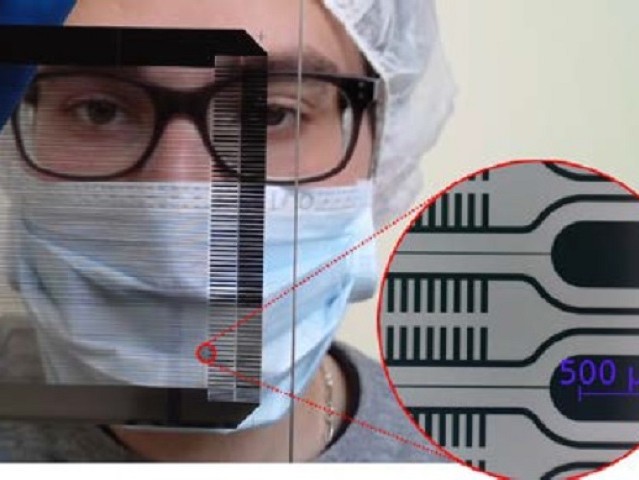
By design, MSGCs are only position sensitive in one dimension and SINE2020's aim is to make them two dimensional (2D) for reflectometry techniques at neutron sources and to achieve a 1mm resolution. How they work MSGCs function in a similar way to another style of detector: Multi Wires Proportional Chambers. However, because the electrodes in MSGCs are close together and lie in one plane they have great potential to provide higher counting rate capabilities and improved spatial resolution. Microstrip gas chambers consist of thin metallic anode and cathode strips on an insulating glass substrate. The strips are chemically etched onto the substrate using photolithography. This set-up is placed in a gas chamber filled with 3He as a neutron converter and another gas as a stopping gas. When neutrons enter the detector, they hit helium. The reaction products start an ionization process in the chamber and the resulting charged particles move towards the electrodes. The stopping gas limits the range of these particles to improve spatial resolution. Electrons drift toward the anodes until they reach the region of intense Electric Field, where charge multiplication occurs. This so called avalanche makes the measurement detectable by the electrodes. Several components of the detector can be varied. The mixture of gas used inside the chamber and the size, layout and materials of the electrode plate can all affect the performance of the device. 2D position sensitivity To make an MSGC 2D position sensitive requires either the anodes or the cathodes to be resistive to measure the position along the strips by charge division. The other coordinate is given by the position of the active strips in the perpendicular direction. One difficulty comes from the fact that the resistance of the electrode must be in a typical range of 5-10 kOhm. By using Chromium, anode strips are generally too resistive, and cathode strips are generally not resistive enough. The project For SINE2020, Bruno and Damien investigated a novel resistive cathode layout. Here the cathodes consist of two half-cathodes made from pure chromium surrounding the same anode, and connected to each other on both ends. One half-cathode is made of teeth connected by a resistive line. The resistivity of the cathode can be varied by adjusting the width of the half-cathode resistive line. The cathode signals are used for localizing each particle in both dimensions – Y along the strips and X perpendicular to the strips. The electrical resistance of the cathode strips results in a variable signal height measured at both ends of the strips; the closer the strip connection is to the neutron interaction, the higher the signal is on the amplifier connected to this strip; this effect is exploited to measure the Y coordinate of the neutron impact along the strips. The X coordinate is measured by using a Centre-of-Gravity (CoG) method. This so-called MSGC64 detector prototype was fabricated at the ILL and consists of a Micro-Strip plate produced by IMT (Switzerland) using a Schott S8900 electro-conductive glass substrate containing 64 anodes of 10μm width, and 64 cathodes. The plate was mounted in a gas pressure vessel containing the detection gas 3He/ CF4 mixture at a pressure of 5 bar. Despite the high cost and worldwide shortage of 3He, the decision to keep this as the neutron converter is based on its potential for performance gain compared to the relatively low volumes required (only a few litres). The overall dimension of the MSGC is 101mm x 101mm, and its sensitive area is 64mm x 64mm. The detector was set-up, calibrated and tested. Resolution is better than 1.2mm in the Y direction and 1mm in the X direction. The device worked well but at higher counting rates issues have arisen. To overcome them the team are trying to replace the resistive charge division by a geometrical charge division and the team are currently awaiting a new plate with triangular cathodes to test this.
Keywords
Countries
France