New life for steel production ladle lining's

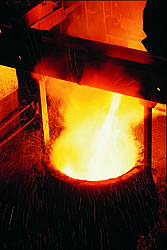
The method used for the development of the ladle lining involved taking the basic research and focusing it on the unexplored chemical compositions of the ternary diagram of A1203-Mg0-Ca0 (Alumina-Magnesium-Calcium). As a result, the cement matrix developed, was characterised by its physical chemical properties, thermo-mechanical behaviour and the microstructure features. To provide a complete breakdown of the chemical compositions and manufacturing processes, the qualification of materials and the procedures for castable and gunnable refractory products were stated. Corrosion resistance, molten steel penetration and slag attack was also investigated, thus enabling the selection of the final refractory product composition. In order to validate the theoretical conclusions, several trials were carried out, which involved two steel factories with 130 and 250 tonne ladles. Verification was made by assessing, the lining procedures, repair compounds applications, pre-heating and firing conditions at various stages of the secondary steel process. The trials also focused on penetration resistance, corrosion, wear rate, thermo-mechanical properties and spalling effects. These trials were conducted at 1650 degrees Celsius so that standard operating temperatures could verify all the expected corrosion and penetration attacks. As a result and compared to the basic high Alumina materials in current use, the spinel high Alumina materials demonstrated a significant increase in the ladle lining life span and stability. Further, the results from the trials also showed that the wall linings exceeded 298 heats, whereas bottom-lining heats attained 860 heats. The conclusive results that were drawn up and compared to current ladle lining performances, proved beyond doubt that the availability, reliability and worldwide marketing is exceptionally impressive. And this is especially true due to the industrial crossover potential of this refractory, which includes Portland cement rotary kilns, waste incinerator furnaces and glass furnace heat exchangers.