Benchmarking the EU poultry industry

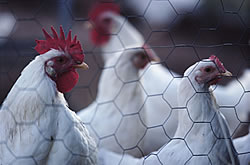
The high product quality and the good health and welfare of breeder hens are of primary importance in the poultry industry. Specific reproduction schemes, feeding plans, genetic techniques, or their combination are used in order to meet the high quality objective. However, although rationing may improve poultry health and their reproduction system, it may lead to undue hunger. Understanding the relationship between product quality and genetics and nutrition of breeders can shed light on potential opportunities for quality improvements. The BBP project aimed at improving the production in an existing conventional farming system by exploring the interaction between reproduction, feed restriction and different genotypes of broiler breeders. In order to define chick quality, a scoring method was developed and applied to assess day-old chick quality under several major genetic and environmental conditions. Physical criteria for day-old chicks include: activity, down appearance, abdominal content of yolk, condition of eyes, legs, navel, membranes and residual yolk. Each parameter is scored according to importance with a maximum cumulative total of 100. The maximal score of 100 indicates the anomaly free high chick quality, while scores less than 100 reflect moderate or poor quality. Results using this scoring system show that there is a link between chick quality and embryonic physiological parameters such as heat production. Generally, low quality chicks hatch from eggs that underwent longer incubation. Better chick quality resulted in better liveability and faster growth in broilers while low quality chicks have lower relative growth in the first week post-hatch. The scoring method can be applied to any hatchery to evaluate the potential quality of the hatched chicks. Its application will provide an improvement in the quality of the poultry industry both in terms of the adjustment of the incubators and procedures and estimation of the liveability and growth potential of the chicks. Incubator companies, hatcheries and genetic selection breeders are now invited to seize the opportunity for further development and exploitation.