


NEW DATA CONFIRMING OUR THEORY OF "CONDITIONING", OR A STRENGTHENED OPTION FOR MAINTAINING A STABLE TEMPERATURE IN THE BEE'S NEST.
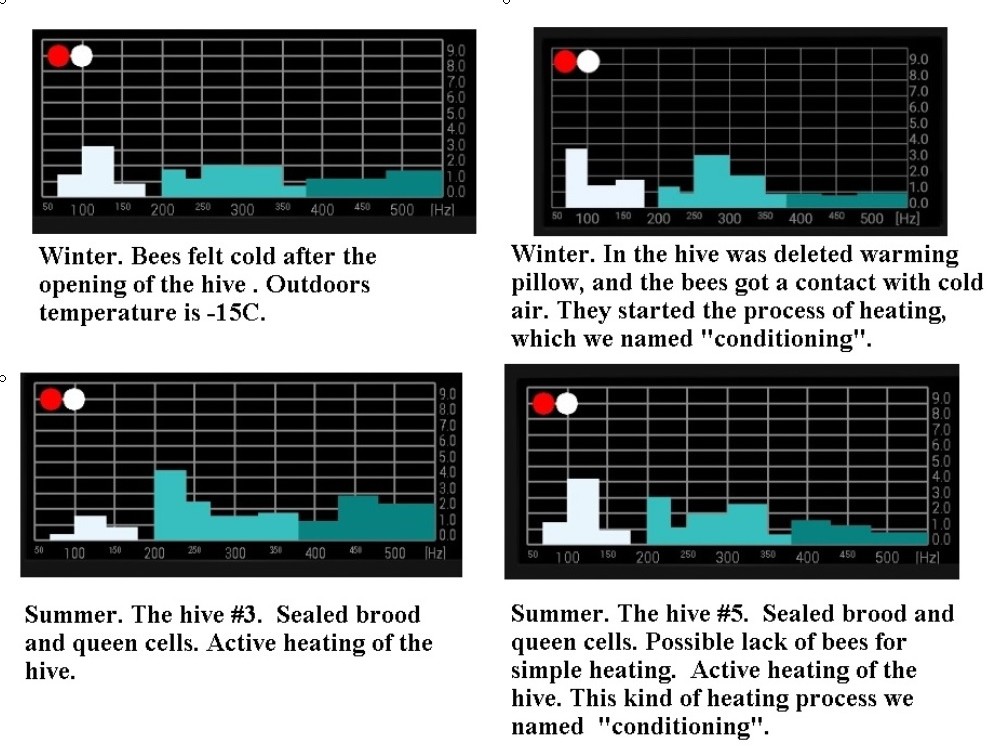
Recently, we conducted an experiment on cooling the nest of hibernating bees with the fixation of changes in the background signals in the hive. The results were very interesting. At the outside temperature of -15C, we received data, possibly confirming our hypothesis about the "conditioning" of the hive, that is, the use of ventilation of lowest force, in order to improve the heat removal from the bee's body in emergency moments of severe cooling of the nest. We assumed that in addition to heating, which is usually silent, heating with the performance of flapping of the wings can be used by the bees. This reduces the resonant frequency of vibration of the muscles of the thorax of the bee, but adds improved heat removal and provides forced convection. When we removed the warming pillow and left only a thin fabric, separating the upper part of the wintering bees cluster from the street and made measurements, we saw how the signals characteristic for various jobs in the warm nest began to change, and turned into signals of the lowest frequencies' ventilation, and thorax vibrations which in sum provide the best heating and convection of warm air. When the pillow was returned, after 20-30 minutes, the signals changed again, and began to correspond to the performance of in-hive works and feeding... We managed to simulate this situation two times in a row. The predominant signals were - heating and convection. Further research conducted using our archives showed that this situation is not unique. The same signals were recorded in the summer in a very specific situation. This once again confirms the immutability of the principle of life support in bees, and its independence from the season of the year. The appearance of the signals was absolutely similar to our winter emergency heating, but was recorded in June, in the family, in which there was sealed brood and queen cells. And we already expected a close exit of the first queens. It should be noted, that at this time, in June, it was pretty cool. The bees in the hive were less than they needed, because these families, in which we were waiting for the queens, were practically divided in half. Thus, the number and age composition of bees in these families did not allow them to use passive or active heating. And the bees used the most efficient heating with convection, or as we called this effect - "conditioning". Thus, we can once again say, that we believe, that there are four modes of thermoregulation in bees. - Maintenance of heat due to thermal insulation and the creation of clusters; - Passive heating with virtually no vibration of the thorax; - Active heating with powerful vibration of thorax and creation of vibro-acoustic signals in the low-frequency zone of the working range, without the participation of the wings, which are fixed in a slightly open position; - Active "conditioning", or active heating, with the work of the muscles of the thorax in resonance mode, similar to ventilation, but in which the wings operate at extremely low frequency, creating a weak air flow, providing improved removal of heat from the bee's body. Our observations and experiments will be continued ...
Keywords
Countries
Spain, France, United Kingdom, United States