


THE REASONS FOR NECESSITY OF WARMING UP OF THE BEEHIVES OF FAMILIES NOT IN WINTER TIME, BUT IN SUMMER BEFORE SWARMING PERIOD.
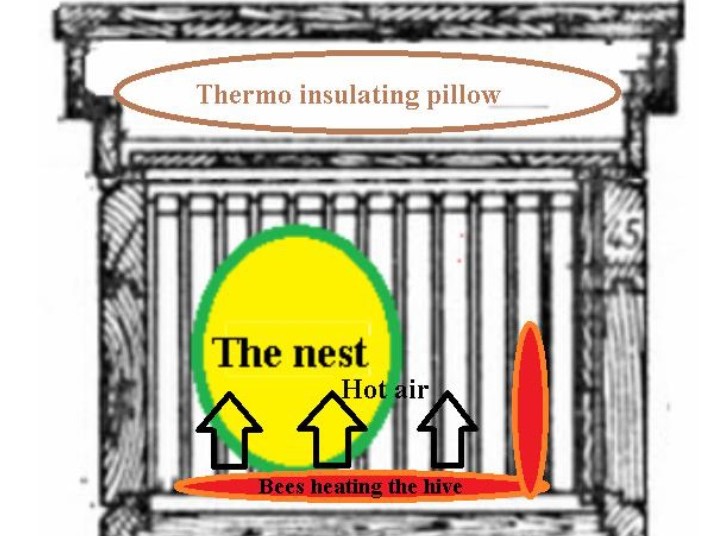
What are the bees that are engaged in heating of the family? Microcalorimetric measurements of heat generation for three castes of the honeybee - workers, drones, and queens of different ages - were performed. Among these groups, adult worker bees showed the highest rates of heat production. Let's have a look at the diagram of interdependence of parameters of bees, placed on the surface of the combs. Flight bees at the age of more than 22 days, in the maximum quantity - i.e. in quantities exceeding the number of bees of the other ages - are located in places where there is no brood. And in these places there are both resting (or "passive") flight bees, the temperature of which is minimal -15C, as well as the bees engaged in active heating of the hive, the temperature of which varies from 25C to 34C. So, we can say that obtained results clearly show the presence of "active heating" in places where there is no brood - that is, along the periphery of the nest, including the bottom of the frames. This shows the presence of "active heating" with the participation of flight bees, which, as we said, at the moment preceding the swarming, many flight bees engage in this work, reducing the productivity of the families. A non-trivial conclusion follows from this: it is necessary to warm bees' families exactly in the pre-swarming period, in order to significantly reduce the loss of early honey in apiaries, and this will improve development of the families. We know very well that when there is a lot of brood in the hive, and especially if there are queen cells, a very large number of bees remain in the hive. The task of young bees is to feed the brood, and the task of the old worker bees is to heat the hive. This is especially true for heat-loving bees, and for the Russian bee, without any doubt, because it is known that Russian bees for normal life require temperatures 4-6 degrees higher than the bees of rocks, such as the Carnica breed. This is especially important at the moment of time before swarming. At this moment, in the nest there exists a maximally possible amount of open and sealed broods. And, it is well known that the sealed brood requires even more thorough heating than the open brood. Austrian scientists argue that the stability of temperatures in the hive during the ripening period of the sealed brood is much more important than during the period when eggs and larvae are heated. Even the slightest drop in temperature below 32C leads to mass ugliness in the resulting adult bees. And this is a serious factor, which means that maintaining a stable, high temperature in the zone of the sealed brood is a factor of family survival. And it's not a fact that honey collection is more important at the moment ... (Honeybee Colony Thermoregulation – Regulatory Mechanisms and Contribution of Individuals in Dependence on Age, Location and Thermal Stress, Anton Stabentheiner*, Helmut Kovac*, Robert Brodschneider, Institut für Zoologie, Karl-Franzens - Universitat Graz, Graz, Austria). We believe that in relation to the future queens, it is even more important!!! Thus, reducing the excess volume of the hive and warming of the hive and the nest in May-June, immediately before swarming, will significantly reduce the family's need for heating of empty space, and improve heat retention. Such simple measures will free a significant number of adult flight bees, which can continue flying for nectar, and will accelerate the development of the brood, due to the possibility of maintaining higher temperatures directly on the brood frames, which in turn will accelerate the maturation of the brood, and will accelerate buildup of forces of bee families. This is how an understanding of the breed characteristics of bees can help to improve the economic performance of an apiary with minimal efforts.
Countries
Spain, United Kingdom, United States