



Tracing light echoes

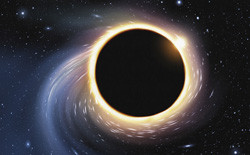
Supermassive black holes are enormous concentrations of matter, weighing billions of times the mass of the Sun. A small fraction of these black holes feed on material from their surroundings at extraordinary rates, leading to the creation of a disc of material that spirals around the black hole. Heated by internal friction up to millions of degrees, the accreting matter radiates profusely at ultraviolet, X-ray, and optical wavelengths, making these objects visible across most of the observable universe. Astronomers working on the 'Advancements in black hole physics with echo mapping experiments' (REVERB_MASS) project dedicated great efforts to detecting changes in the radiation from the innermost parts of accretion discs and surrounding matter. They searched for and found 'reverberation', namely light emitted by the accretion disc and then absorbed and re-emitted by the surrounding matter. The two signals are detected independently and separated by a time delay that provides researchers with the physical distance between the accretion disk and surrounding matter. Astronomers can examine the broadening of the echoed, or reverberated, emission line signal from hydrogen and ionised carbon atoms to measure the velocity of the surrounding matter. Using data from the Hubble Space Telescope, the Sloan Digital Sky Survey and the Large Binocular Telescope on the ground, REVERB_MASS scientists applied new methods to combine the velocities and distances of the matter surrounding the black hole to estimate the mass of the black holes with precision higher than ever before possible. REVERB_MASS also investigated using photometric observations to measure this time delay, instead of the traditionally used spectroscopic ones that divide the light by wavelength — just like a prism splits white light into the colours of the spectrum, but with much higher precision. Advances such as this will have significant implications for applying these methods to large numbers of very distant accreting black holes whose light will be observed with the upcoming Large Synoptic Survey Telescope. New reverberation mapping programmes to apply these methods to multiple atomic species of matter around very distant black holes have been proposed and carried out with the spectrometer on the Very Large Telescope in Chile. These studies will propel the science of accreting supermassive black holes into a fundamental new era of mapping. The results of the REVERB_MASS project are described in four papers published in international peer-reviewed journals.