From laminar flow to turbulence

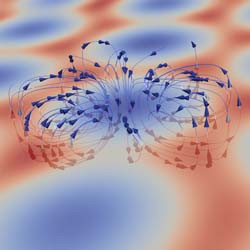
In volumetrically heated fluids, the heat can come from chemical or biochemical reactions, a phase transition or radioactive decay. Volumetric heating is behind convection in clouds and effects on weather patterns. It is also responsible for the transport of humidity in greenhouses and its effects on weather and plant growth. Industrially, it is involved in a number of processes in nuclear reactors, including decay heat removal and convection of molten reactor cores. Many computational fluid dynamics (CFD) models are focused on the fully developed turbulent state. The EU-funded project T2T-VHF (Transition to turbulence of volumetrically heated flows) sought to develop mathematical models that capture the transition from uniform laminar flow to the chaotic flow of turbulence. In particular, scientists studied the pre-chaotic bifurcation behaviour of strongly non-linear equilibrium solutions for incompressible volumetrically heated shear flows (VHSFs) in a long channel. The models will enable design for control of that transition and, when unified with turbulent flow models, provide a holistic picture of fluid flow through its entire evolution. The transition to turbulence of VHSFs was modelled using both spectral stability analysis and CFD (finite volume methods). The former easily and quickly identifies stable and unstable flow states, but requires careful representation of the geometries considered, which can be quite complicated. The goal was to create a toolbox facilitating amendments to the finite element code such that it can model flow states in more complex geometries currently not possible with the spectral method. Scientists focused on the complex state space found using the spectral stability analysis for conditions of constant pressure gradient. This allowed them to clearly understand the state space at the transition from laminar conduction to laminar convection to unsteady coherent wavy flow. Model results were largely consistent with experimental data in the literature. Work was presented at several conferences and meetings as well as in peer-reviewed scientific journals. The advanced models describing the transition from laminar to turbulent flow of VHSFs in a long channel are expected to extend the performance capability of existing descriptions. They could find application in numerous fields, from weather patterns to nuclear energy.