


Researchers capture exotic form of radioactivity on camera
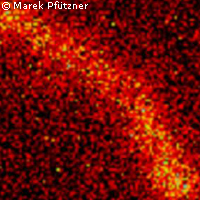
A detector built by a Polish group of scientists from the University of Warsaw has led to new insights into how nuclei spontaneously eject various particles in radioactive decay. It has enabled an international collaboration of European and US researchers, led by Polish physicist Dr Marek Pfützner, to take a closer look at the radioactive decay of a rare iron isotope. Until now, measuring fleeting, exotic nuclei has been largely impossible. Understanding of the exotic form of radioactivity of the iron-45 isotope has thus been poor. A novel combination of advanced physics equipment and imaging technology found in most off-the-shelf digital cameras has done the trick. 'We have proven in a direct and clear way that this extremely neutron-deficient nucleus disintegrates by the simultaneous emission of two protons,' write the authors of a paper published in Physical Review Letters. The radioactive decay of the rare iron-45 isotope, which consists of a nucleus with 26 protons and 19 neutrons, as opposed to the stable form of iron with 26 protons and 30 neutrons, is exotic in as far as it exhibits two-proton emissions. There were two possible explanations for this unusual pattern: Either the isotope occasionally released an energetically linked two-proton pair also known as a diproton, or the protons were emitted in quick succession or even simultaneously but were unlinked. Using a gas chamber to slow down a beam of rare isotopes and a high-end digital camera to record the trajectories of emitted protons from the decaying iron-45 nuclei, the scientists involved found that the diproton theory could be ruled out. The correlations between emitted protons could best be described as a form of nuclear transformations known as three-body decay. In addition to shedding light on a novel form of radioactive decay, the technique could lead to additional discoveries about fleeting, rare isotopes studied at accelerator facilities. These isotopes may hold the key to understanding processes inside neutron stars and determining the limits of nuclear existence. The study was conducted by Polish, Russian and US researchers at the National Superconducting Cyclotron Laboratory (NSCL) of Michigan State University. It was supported by the Polish Ministry of Science and Higher Education as well as the US National Science Foundation and the US Department of Energy.
Countries
Poland