


Project puts cancer cells under magnifying glass
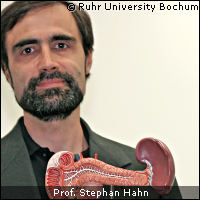
The EU-funded MolDiag-Paca project (Novel molecular diagnostic tools for the prevention and diagnosis of pancreatic cancer) is investigating new methods for early detection of pancreatic cancer with the help of molecular imaging. Ultimately, the project aims to develop imaging methods that will be able to detect smallest amounts of cancer or cancer precursor cells in the human body. The initial idea put forward by Professor Stephan Hahn of Ruhr University Bochum, Germany, and his colleagues involved in the project, was that a pancreatic tumour, which had been surgically removed, would have to contain all stages of cell mutation from healthy tissue to fully developed cancer cells. On the basis of their analyses, the research teams were able to draw up a four-stage model of pancreatic cancer, identifying a particular microscopic lesion - a so-called pancreatic intraepithelial neoplasia (PanIN) - as an indicator. After having developed a progression model, the scientists went on to isolate a number of proteins or more correctly messengerRNA (mRNA) - an intermediary stage between protein and DNA - which frequently occurs in pancreatic cancer precursor cells and might be used as a marker. Now, the project partners are working on creating binding molecules and detection strategies for five proteins identified as markers - 'a biological magnifying glass', Professor Hahn explains. Two different procedures are currently being tested on cell cultures: One uses a radioactive diagnostic agent, which will be injected into the blood stream, so that abnormal cells can then be detected with the help of positron emission tomography (PET). The second method involves a fluorescent probe that will enable endoscopic detection of mutated cells. According to Professor Hahn, it will take at least three years to verify whether these methods work. Only then can they be tested in a clinical trial. 'We would be very happy if we could securely detect PanIn-3,' Professor Hahn says. 'We are not talking about a great number of cells. The question is whether we will be able to generate sufficient signal strength at the lesion, so that we can identify it from the outside.' A study published in 2006 in the journal Cancer Epidemiology, Biomarkers and Prevention states that pancreatic cancer is the sixth most common cause of cancer mortality in the EU, amounting to about 55,000 deaths every year. It is a type of cancer that - in its early stages - does not show any symptoms. When symptoms finally start, the cancer will already have metastasised in 80% of cases. In addition, neither chemotherapy nor surgery tend to be very effective in treating later stages of pancreatic cancer. As a result, 95% of patients pass away within the first year after diagnosis.
Countries
Germany