


First satellites launched for EU's Galileo smart navigation system
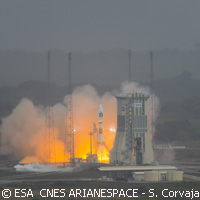
Historic steps were taken on Friday 21 October as the first pair of satellites for Europe's Galileo global navigation satellite system were launched into orbit from the European Space Agency's (ESA) spaceport in Kourou, French Guiana. The Galileo programme aims to give citizens and businesses direct access to a satellite navigation signal powered in Europe. Adding further historical gravitas to the occasion, the two European satellites were launched from the Russian Soyuz launcher, the same launcher that was used for Sputnik and Yuri Gagarin. Both satellites exceeded their target orbit of 23,000 kilometres 3 hours 49 minutes after liftoff. This was the first time a Soyuz launcher took off from a site outside of Baikonur in Kazakhstan or Plesetsk in Russia, as launching from close to the equator means the Soyuz can carry up to 3 tonnes into the 'geostationary transfer orbit' typically required by commercial telecommunications satellites, compared to the 1.7 tonnes that can be delivered from Baikonur. 'This launch represents a lot for Europe: we have placed in orbit the first two satellites of Galileo, a system that will position our continent as a world-class player in the strategic domain of satellite navigation, a domain with huge economic perspectives,' comments Jean-Jacques Dordain, Director General of ESA. These two satellites are the pioneering components of a new constellation that will make up a smart satellite navigation system for Europe. The two Galileo satellites launched on the Soyuz are part of the In-Orbit Validation (IOV) phase that will see the Galileo system's space, ground and user segments extensively tested. Eventually, they will be joined by other satellites to make up a 30-strong fleet and the hope is that such a system will bring many economic benefits and inspire further growth and innovation. Vice-President of the European Commission, responsible for Industry and Entrepreneurship Antonio Tajani says: 'This is a proud moment for all Europeans; today's launch is proof of Europe's prowess in the field of space activities. I now call on European industry and SMEs, to seize without delay the important economic opportunities offered by this system - get innovating now! European citizens can get ready, Galileo is about to be a part of our daily lives.' Once the full system is up and running, expected from 2014, it will enable improved services ranging from more precise in-car navigation, effective road transport management, search and rescue services, more secure banking transactions and reliable electricity provision. Whilst we may not always realise it, these services all rely heavily on satellite navigation technologies to work efficiently. The system is predicted to generate around EUR 90 billion of additional revenues for industry over the next 20 years. The European Galileo satellite navigation system is a civilian-controlled system, unlike the Global Positioning System (GPS) used in the United States that is run by the military. Galileo is interoperable and compatible with GPS. The satellites are now being controlled by the ESA and the French space agency Centre National d'Etudes Spatiales (CNES). The next two Galileo satellites are scheduled to be launched in summer 2012. Jean-Jacques Dordain explains that the launch is a symbol of 'cooperation between ESA and Russia, with a strong essential contribution of France; and cooperation between ESA and the European Union, in a joint initiative with the EU.' He continues: 'This launch consolidates Europe's pivotal role in space cooperation at the global level. All that has been possible thanks to the vision and commitment of ESA member states.'For more information, please visit:Galileo:http://ec.europa.eu/enterprise/policies/satnav/galileo/index_en.htm
Countries
France, Russia