Improving autonomy for self-driving spacecraft

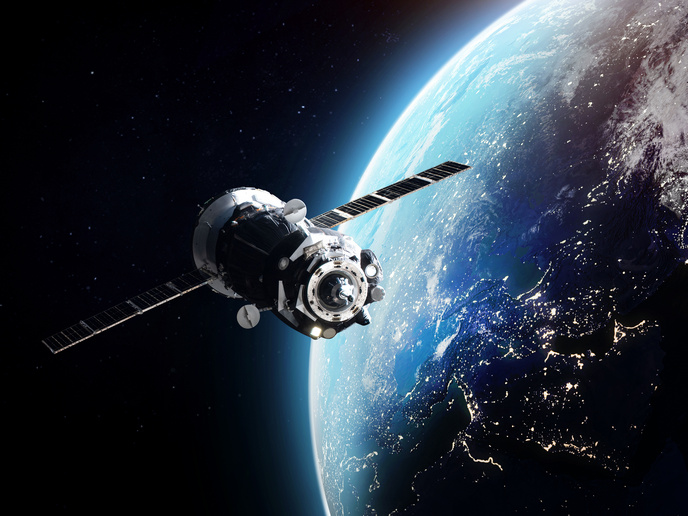
With countless satellites in orbit and routine rocket launches, humanity is well into the space age. Yet despite huge progress in automation, many operations in space are still manually controlled by humans. “From manoeuvres to scientific operations, almost any activity is typically preplanned by teams of engineers on the ground,” explains Ethan Ryan Burnett, formerly at the Polytechnic University of Milan(opens in new window) (Polimi) and soon to be assistant professor at the University of Texas at Austin. “This lag of automation in space has occurred for two reasons: space missions are very costly, so agencies are naturally risk-averse to autonomous experiments; and the computers onboard the spacecraft are very slow compared to their terrestrial counterparts.” These computers are built to resist the harsh environment of high-energy particles found in space, which means the types of algorithms that can be run onboard are very limited, and flight software must be designed with a low computational footprint. In the EU-funded FAAST project, Burnett and his team developed new and efficient guidance and control algorithms for small and interplanetary spacecraft. “Traditionally one might associate low computational footprint with low capability, but in FAAST we hope to show that that’s not quite right.” The main goal of FAAST was to design trustworthy, low-footprint autonomous guidance algorithms, which if widely adopted could greatly lower mission operation costs. These currently range(opens in new window) from 10 % to 50 % of total mission costs for longer missions. “This is one cost innovation that could help make space more accessible on a lower budget. It would also enable more capable spacecraft, which could help unlock new types of fully autonomous space missions that have not been seen before,” Burnett notes.
Developing new guidance and control algorithms
FAAST focused on developing algorithms that govern the trajectory of a spacecraft based on its current position and velocity, an objective or set of goals, and problems including, for example, avoiding dangerous objects in space. The project applied many mathematical and computational methods, but two were most important. The first was convex optimisation, a family of stable algorithms that efficiently solve equations if they are put in certain standard forms. The second method was to precompute information needed to plan a trajectory so the guidance tool doesn’t need to solve complex equations onboard. After developing prototypes, the team tested the algorithms first on computers, then in an experimental setting. “As the work for FAAST has continued beyond the Marie Skłodowska-Curie Actions(opens in new window) fellowship period, we hope in the coming months to start testing the algorithms of FAAST on flight-like hardware,” remarks Burnett.
Towards flight-like testing
Much of the work is under peer review to be published in scientific journals. The first paper for the project was published in the ‘Journal of Guidance, Control, and Dynamics’(opens in new window) and showcases a guidance method developed in the project that runs quickly on a laptop. “What we’ll test in the coming months is how long it takes on flight-like hardware, which is slower,” says Burnett. “As these algorithms are used to plan hours or days of operations, we hope that a slowdown to say, a few minutes, won’t be a big obstacle.” Beyond the upcoming flight-like testing, Burnett is also working on next steps in technology development of the algorithms themselves. “The current task is incorporating knowledge of uncertainties into the algorithm,” he adds.