Atmospheric connections between stars and exoplanets

Astronomers have been able to confirm the existence of more than 6 000 exoplanets in our galaxy, orbiting stars other than our own Sun. Most of these planets are identified when they pass in front of their star, causing a temporary dip in brightness. “Given our current instrumentation, exoplanets that pass close to their star are easier to find,” explains ASTROFLOW(opens in new window) project coordinator Aline Vidotto from the University of Leiden(opens in new window) in the Netherlands. “These discoveries are exciting because these planets are like laboratories, helping us to understand what is happening close to stars.”
Investigating planetary atmospheric escape
The ASTROFLOW project, which was supported by the European Research Council(opens in new window), sought to use these exoplanets as ‘labs’, to study how stars and planets that orbit close to them interact. In particular, Vidotto wanted to know how this interaction affects atmospheric escape. This could shed new light on early planet evolution, including that of our own. Scientists know that planets, including the young Earth, lose mass, often through their atmospheres escaping into space due to stellar radiation (a process known as photoevaporation). The exoplanets that ASTROFLOW looked at had to be large enough for atmospheric escape to be detected (the distances involved are mind-boggling, given that the exoplanet nearest to us is over four light years away). At the same time, many were closer to their star than Mercury is to our own Sun.
Modelling stellar winds
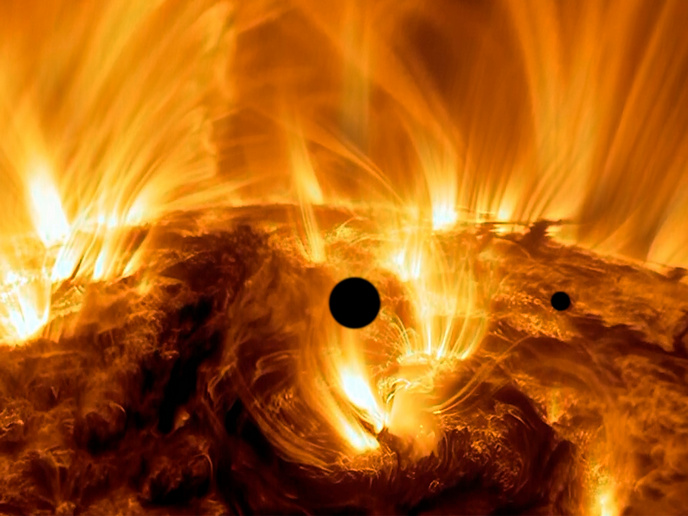
First, the project team modelled ejected material – called stellar winds – emanating from their target stars. “You can think of stellar winds as a fluid that flows outwards,” says Vidotto. “We modelled these winds three-dimensionally, taking into account density, velocity and various forces like magnetic fields.” Next, the team developed models to explain atmospheric escape emanating from the nearby exoplanets. These models were then combined, to create a picture of how the atmospheres of these close planets and stars interact. This modelling enabled the team to make a number of new findings. “We found that if a planet orbits in a region where the stellar wind is dominated by magnetic energy, then atmospheric escape happens mostly through a single polar region,” notes Vidotto. “It looked as if one of the poles had disappeared.” The team eventually realised that because of the magnetically dominated stellar wind, one of the poles was in effect directly connected to its star. In other words, it formed a kind of ‘tube’ of atmospheric evaporation – the first time this has been identified.
Understanding our own planetary evolution
These findings could help us to better understand our own planetary evolution. We think that Earth’s atmosphere once contained a lot more hydrogen and helium, which was then stripped away, probably through the mechanism that ASTROFLOW studied – photoevaporation. Vidotto would like to build on this groundbreaking work, by creating models that take account of other atmospheric escape gases such as helium. “We would also like to find out if our models can be applied to exoplanets orbiting further out from their star,” she says. ASTROFLOW’s work also coincides with two ongoing space missions that have sent probes into orbit close to our Sun – Solar Orbiter(opens in new window) from the European Space Agency, and the Parker Solar Probe from NASA. Both missions aim to learn more about stellar winds. “The exoplanets we studied were a little like nature’s probes,” adds Vidotto.