Modelling of SGTR and its impact on PSA studies

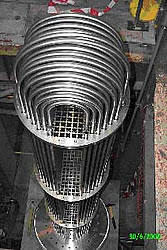
In a nuclear reactor, the process that produces heat is the fissioning (splitting) of uranium atoms that are located in the reactor core. This heat is transferred away from the core by two loops, primary and secondary. Circulating water in the primary loop is heated. This loop passes through a steam generator, where it warms the secondary loop via a heat exchanger tube 'bundle', usually a large number of U-shaped tubes. The problem addressed is steam generator tube rupture (SGTR) in Pressurised Water Reactors (PWR). The tubes inside the steam generator degrade over time. Ultimately this can lead to tube rupture which, when coupled with other failures can result in the release of radioactive fission products from the primary circuit into the secondary circuit and into the environment. The severity of this release is reduced if most of these radioactive products are retained inside the steam generator, and the aim of the SGTR project is to create a database with information on fission product retention potential. The most important accident scenarios were specified on the basis of existing Probabilistic Safety Assessment (PSA) studies, which assess the routes whereby radioactive release can occur following damage and estimate the magnitude and frequency of occurrence. From these the key boundary conditions for the experimental studies were determined as being: dry and wet conditions on the secondary side, the number of broken tubes, the severity and location of the damage, break flow, fission product concentration and the flooding rate. Scaled down models of two types of PWR steam generators were used to study the retention of fission products in the steam generator tubes and in the secondary side of the reactor. Although there remain many areas that need further research, the project has answered significant questions concerning aerosol deposition and re-suspension in the event of tube rupture. The information can be used to assess the efficiency of different accident management strategies thus improving reactor safety.