Accurate detection of water pollution

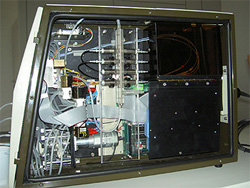
Maintaining water quality is a worldwide challenge in the twenty-first century. In the effort to detect water pollution faster with greater accuracy and in remote locations, a prototype was developed in the framework of the SEWING project. The prototype employs Chemical Field Effect Transistor (CHEMFET) sensors to detect non-organic ions in the sampled water. Up to seven sensors can be employed, measuring waterborne pollutants such as nitrate and ammonia. The SEWING prototype is designed to be portable for field use. The sensors, system hydraulics, electronics and other internal components are housed in an IP-55 case, ensuring resistance to a wide variety of unfriendly environmental conditions. Power is provided by an external 12V power supply. An electronic display as well as a keyboard and printer are installed on the front panel of the unit. An RS-232 port ensures straightforward connectability to either a PC or a datalogger for data collection. Patented Loop Flow Reactor (LFR) and Loop Flow Analysis (LFA) technology are used to facilitate the simultaneous measurement of up to seven different pollutants. The prototype also houses a reference electrode and a temperature sensor. Both front-side connected (FSC) and back-side connected (BSC) CHEMFET configurations are possible. Systea, the SEWING partner in charge of putting together the prototype, experimented with a number of different components to handle the signal generated by the CHEMFET sensors. The optimal solution was achieved using commercially available analogue to digital (A/D) and digital to analogue (D/A) components to measure the drain currents from the sensors. In addition to housing seven CHEMFET sensors, the SEWING prototype can potentially be expanded to incorporate other types of sensors. Systea seeks partners to help mature the prototype into a commercial product. More information on the prototype is available from: http://www.sewing.mixdes.org(opens in new window)