Precise motion control on nanoscales

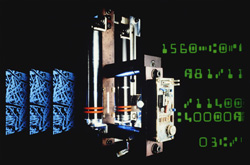
Piezoelectric actuators are very well suited to replace manual positioning elements as well as motorized systems. Their relatively simple control and high positioning resolution make them ideal to drive micro-robots and miniaturised micro-positioning systems. With a decreasing size of these systems, new concepts were required for the piezoelectric actuators, which would provide for fabrication in small-sized batches and importantly result in reproducible parameters. Within the framework of the MICRON project, a new methodology was proposed that allows integrating monolithically a number of actuators on a single piezoelectric ceramic substrate by simple electrode patterning. The monolithic approach presents several advantages compared to individually mounted actuators which are commonly used in inertial driven systems. No machining or forming of the piezoceramic substrate is necessitated, avoiding problems of assembling and consequently reducing production costs. The modelling of the Monolithic PiezoActuator (MPA) using analytical and numerical tools permitted the in-depth study of its geometrical configuration. These models have shown that the resonance frequencies are very high, allowing driving at high velocities and therefore yielding excellent dynamics for systems built using this actuator. Overall, thanks to the innovative positioning of the electrodes, the MPA can control centimetre motion with nanometre accuracy. The MPA, developed at the École Polytechnique Fédérale de Lausanne, is a compact and of simple configuration piezoactuator that can be integrated into more complex systems. The potential applications are numerous, especially as this actuator is easily custom-tailored. Apart form positioning devices for optical and electronic microscopy and micro-invasive surgery, the miniaturisation of manufacturing processes and industrial assembly of microengineering products requires such affordable manipulation tools of high performances. Furthermore, machining techniques have been investigated to produce prototypes with good reliability. Laser cutting was mainly used, but other machining techniques such as the chemical etching for the electrodes pattern are a potential solution for future developments. The research team at the Laboratoire de systèmes robotiques is seeking industrial partners that will integrate the Monolithic Piezoactuator into their products.