The brains behind an artificial body

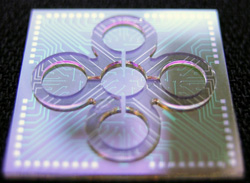
The brain has a functional plasticity which makes it capable of adapting its performance from previous experience. This property is a challenge for science both in terms of understanding and for implementation in physical devices. In this direction, in vitro cultured neurons were used in order to form a bi-dimensional physical model of the brain. The NEUROBIT project aimed at developing algorithms and techniques that allow the establishment of a bi-directional connection between cultured neurons and external devices. The neural populations were incorporated with an actual physical body, such as a mobile robot, and the mechanisms of sensorimotor integration, control and adaptation in living systems observed. In the context of the project a Neurophysiological Mini Laboratory (NML) was developed for interfacing a cultured neuronal tissue. It is a microsystem consisting of a microtransducer array (MTA), temperature sensors, heating elements, a glass reservoir and a mini-incubation chamber. The MTA is based on a microelectrode array (MEA) integrated on a transparent substrate and packaged on a printed circuit board (PCB). The MTA integrates an array of sixty Platinum (Pt) thin-film electrodes for electrical recording and stimulation of network activity. The clustering structures for building the network in interconnected sub-populations have been realized using SU-8 technology. A glass ring glued on the PCB defines a reservoir of culture media. The reservoir is closed by a semi-permeable membrane, in order to limit the media evaporation. The MTA can be integrated in an incubator chamber, fabricated from Polymethyl methacrylate (PMMA), in the framework of NEUROBIT. Heating elements are fixed on the internal side of the chamber and on the top-cover in order to avoid vapor condensation. Moreover they are commercially available, selected on the basis of the minimal power needed. The NML realized exploits thin-film technology, micromachining and commercially available parts for investigating adaptive properties and synaptic plasticity of neuron-robotic models.