Single-electron transistors out of niobium

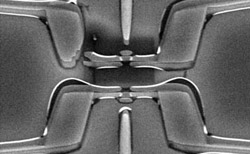
Research on coherent Cooper pair tunnelling in circuits of nanoscale Josephson junctions has demonstrated that they can be operated as qubits or used as building blocks of more complicated superconducting devices. Furthermore, the increased interest in superconducting devices has created a growing demand for simple and reproducible nanofabrication techniques for niobium-based Josephson junctions. Indeed, the superconducting gap of bulk niobium (Nb) is almost one order of magnitude larger than that of aluminium (Al) currently used for the fabrication of most of these devices. The use of niobium could lead to significant improvements in their functioning by improving the signal-to-noise ratio and alleviate the quasi-particle poisoning of small islands. However, the conventional e-beam lithography technique cannot be applied in a straightforward manner for the fabrication of superconducting devices from refractory materials. Researchers at the University of Jyväskylä identified the optimal geometry for the ultra high vacuum chamber to circumvent out-gassing from the polymer resists during the high temperature evaporation. Single Nb-Al junctions were fabricated by applying e-beam lithography on a double layer of polymethyl methacrylate and copolymers resists, followed by two-angle evaporation of Al and Nb. The method could also be used for the production of niobium structures with sizes of about 100nm x 100nm, such as wires and single-electron transistors (SETs). A detailed study of mixed Nb and Al superconducting single-electron transistors has started and the first results indicate these structures are suitable for quantum computation purposes. The low-bias voltage characteristics of a single-electron transistor with an Nb island and Al leads corresponded to resonant transitions between quantum states, determined by the charge transferred through the circuit. Further experiments will be needed to test this simple but robust technique for the nanofabrication of multi-junction structures.