


EUBCE 2017: Biomass and Integration in Future Energy Systems and the Bioeconomy
12 June 2017 - 15 June 2017
Sweden
Over recent years the contribution of biomass to energy, fuels and materials supply has been steadily increasing in response to the need to reduce CO2 emissions from the non-renewable fossil fuels. The EU target for 2020 is to reach a 20% contribution of renewable to energy use with a corresponding aim to achieve a 20% reduction of CO2 emissions; more ambitious targets are projected for post-2020. Biomass contributes to around 60% of the renewable energy needed to reach the 2020 target. Just as in the days before the industrial revolution biomass is not only expected to be used for energy but for the production of biomaterials and biochemicals within a growing and (re)emerging bioeconomy.
EUBCE has for more than 30 years tracked the progress of research and industrial development of modern day uses of biomass. While the broad scope of the conference has changed little over the years, some topics have expanded and developed more than others.
Over recent years the biorefinery approach has grown in importance in order to maximize resource efficiency and indeed to improve financial performance, given the comparatively high value of some non-energy products of biomass. It has also become apparent that it is vital not only to maximise the efficiency of energy recovery from biomass, but that intelligent integration of the delivery of bioenergy into the energy supply infrastructure is essential.
This integration presents a challenge for researchers and industrial users and also opportunities to implement clever solutions that must be financially viable.
In order to achieve CO2 reduction targets, the United Nations Climate Change Conference of Parties (COP) recognizes that all forms of renewable energy and fuels will be needed.
Therefore, the 25th EUBCE has at its heart "The Indispensible Role of Biomass".
The conference in Stockholm (June 12th to 15th 2017) will kick off with examples of industry scale implementation of bioenergy and biofuels projects and an expert panel will discuss the roles for biomass that make it indispensible for the replacement of fossil fuels.
While the IEA reported that renewables surpassed coal in 2015 as the largest source of global electricity generating capacity, clearly more must be done before fossil-free energy can be realized.
Integration is multi-facetted. Over recent years the biogas sector has grown beyond being a provider of base load power to electricity grids. Biogas and it purer form, biomethane which is fully compatible with natural gas, can be stored and used to provide peak electricity demand and indeed demand resulting from low output of other renewable such as wind and solar.
Flexible biogas production and/or utilization can thereby be used to support fluctuating electricity demand and grid stability. Fast pyrolysis is being used to produce a bio-oil for conversion to high quality biofuel that is storable and available for use in transport or as needed for heat and power on demand. Gasification is increasingly being used in an innovative manner to produce synthetic gases that can be used as a replacement for natural gas engine after upgrading.
All of these examples are being currently being demonstrated and new developments in the technologies and related subjects are addressed in Topics 2, 3 and 6 of EUBCE Programme.
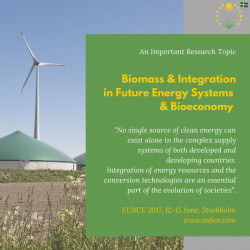
No single source of clean energy can exist alone in the complex supply systems of both developed and developing countries. Integration of energy resources and the conversion technologies are an essential part of the evolution of societies. EUBCE attempts to address the needs from the perspective of the biomass sector.
EUBCE has for more than 30 years tracked the progress of research and industrial development of modern day uses of biomass. While the broad scope of the conference has changed little over the years, some topics have expanded and developed more than others.
Over recent years the biorefinery approach has grown in importance in order to maximize resource efficiency and indeed to improve financial performance, given the comparatively high value of some non-energy products of biomass. It has also become apparent that it is vital not only to maximise the efficiency of energy recovery from biomass, but that intelligent integration of the delivery of bioenergy into the energy supply infrastructure is essential.
This integration presents a challenge for researchers and industrial users and also opportunities to implement clever solutions that must be financially viable.
In order to achieve CO2 reduction targets, the United Nations Climate Change Conference of Parties (COP) recognizes that all forms of renewable energy and fuels will be needed.
Therefore, the 25th EUBCE has at its heart "The Indispensible Role of Biomass".
The conference in Stockholm (June 12th to 15th 2017) will kick off with examples of industry scale implementation of bioenergy and biofuels projects and an expert panel will discuss the roles for biomass that make it indispensible for the replacement of fossil fuels.
While the IEA reported that renewables surpassed coal in 2015 as the largest source of global electricity generating capacity, clearly more must be done before fossil-free energy can be realized.
Integration is multi-facetted. Over recent years the biogas sector has grown beyond being a provider of base load power to electricity grids. Biogas and it purer form, biomethane which is fully compatible with natural gas, can be stored and used to provide peak electricity demand and indeed demand resulting from low output of other renewable such as wind and solar.
Flexible biogas production and/or utilization can thereby be used to support fluctuating electricity demand and grid stability. Fast pyrolysis is being used to produce a bio-oil for conversion to high quality biofuel that is storable and available for use in transport or as needed for heat and power on demand. Gasification is increasingly being used in an innovative manner to produce synthetic gases that can be used as a replacement for natural gas engine after upgrading.
All of these examples are being currently being demonstrated and new developments in the technologies and related subjects are addressed in Topics 2, 3 and 6 of EUBCE Programme.
No single source of clean energy can exist alone in the complex supply systems of both developed and developing countries. Integration of energy resources and the conversion technologies are an essential part of the evolution of societies. EUBCE attempts to address the needs from the perspective of the biomass sector.
Keywords
biomass, bioenergy, biofuels