


CORDIS Express: Europe in space
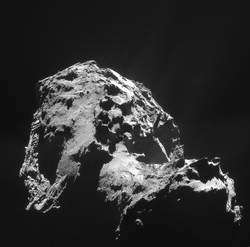
2014 was quite a year for Europe in space. Not only did Rosetta become the first mission in history to rendezvous with a comet, the European Space Agency (ESA) also launched two new Galileo satellites as well as the Sentinel-1 satellite. After 10 years chasing Comet 67P/Churyumov-Gerasimenko, in August 2014, the ESA’s Rosetta made history and headlines by becoming the first spacecraft in history to rendezvous with a comet, escort it as it orbits the Sun, and deploy a lander – Philae – on its surface. The mission, which will continue until the end of 2015, is already feeding back information to help scientists learn more about the role of comets in the evolution of the solar system and the appearance of life on Earth. Not content with that world premiere, later in the same month, the ESA launched two new Galileo satellites to rejoin the four already in space. Despite being released in the wrong orbit, one has already reached its new target orbit and its navigation payload has been successfully switched on. Galileo – Europe’s own global satellite navigation system – will ultimately consist of 30 satellites and their ground infrastructure. The current phase which focuses on extending the constellation of satellites to reach 'Full Operational Capability' (FOC) is being funded by the European Commission. On top of this, earlier in 2014, the Sentinel-1A satellite was launched as part of Europe’s Copernicus environment monitoring programme to provide an all-weather, day-and-night supply of imagery of Earth’s land, oceans and ice. It currently passes over the same spot on Earth every 12 days. Along with these headline activities, many ongoing space research projects, funded by FP7 and Horizon 2020, are taking place in labs, planetariums and universities across Europe. The results of these efforts may feed into the European space programme's giant leaps forward in 2015 and beyond. Future funding opportunities under Horizon 2020 can be accessed through the Participant Portal(opens in new window). This edition of CORDIS Express takes a look at just some of EU-funded space projects already in motion, as well as related news. - Researchers design a Mars rover that can choose its own paths(opens in new window) - Have space suit – will travel(opens in new window) - Trending science: We may have discovered most Earth-like planet beyond our solar system(opens in new window) - Enabling the search for signs of life in space(opens in new window) - New memory design for space applications(opens in new window) - Aerogel European Supplying Unit for Space Applications(opens in new window)
Countries
Belgium