


THE ABILITY TO REMOTELY ESTIMATE THE QUANTITY OF BROOD IN THE BEES' FAMILY. THE FIRST PRACTICAL EXPERIMENT.
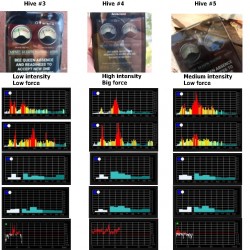
Analysis of data obtained (but not used) by the participants of the European project Swarmonitor, as a part of attempts to control the amount of brood in bees' families with the help of vibration sensors, gave us the possibility for a new look at the many processes taking place in the bee family. Basing on this understanding were born conclusions which now require practical confirmation, which is what we are going to do in 2018. So, on the basis of the obtained diagrams, we can say that the signals generated by the nurse-bees during normal life of the family is not constant, but may be seen only at the time of care for the larvae. The signal is emitted only within a 7-day interval and only at each frame with open brood when feeding and aerating. This is why the signal will not have much strength in the hive. With a small amount of open brood, it will be nearly inaudible. But if there is no work and in the hive there is a large number of simultaneously laid open brood, then it can gain more power and can be heard in the hive, especially in the evening. The signal can be heard in early spring at the beginning of the active and mass egg laying, and in autumn after the end of honey collection, when there is no work on the processing of honey, and the queen still continues to lay eggs. Thus, unlike Woods, we consider the signal to be a sign of activity of nurse-bees, and not a sign of their passivity, as Woods believed. Based on our assumptions, the best time to observe this signal is the beginning of spring, when bees begin to rear new brood. And we tried to analyze the sound background in the appropriate range in three experimental families, two of them families of Carnica breed, and one a crossbred of Russian and Carpatian breeds. The main characteristic of this family is that it released very early swarms. This should mean that this family starts to grow brood very early. This is family number 4. Our device was used in Readiness Control mode. This range, according to Woods, speaks about sense of queenless. And as it turned out, indirectly it was a true statement for a short time period. Though, the reasons differ from the reasons which Woods meant. What were the results we got... Several separate observations using arrow indicators showed the presence of a signal of different force in each family. Then we turned the device to the graph mode, and we finally saw more or less an understandable picture. The signals in all three families were different. So, based on received screenshots, we can assume an essential difference in brood amount, between the hives number 3 and 5 and hive number 4. The brood amount should be, according to our assumptions, significantly larger in hive number 4 than in the other two hives. The signals of the bee-nurses are strong and periodic. The first warm day will help us to find this out for sure!
Keywords
Countries
Canada, Switzerland, Germany, Denmark, Spain, France, Italy, Japan, Norway, Serbia, Sweden, United Kingdom, United States