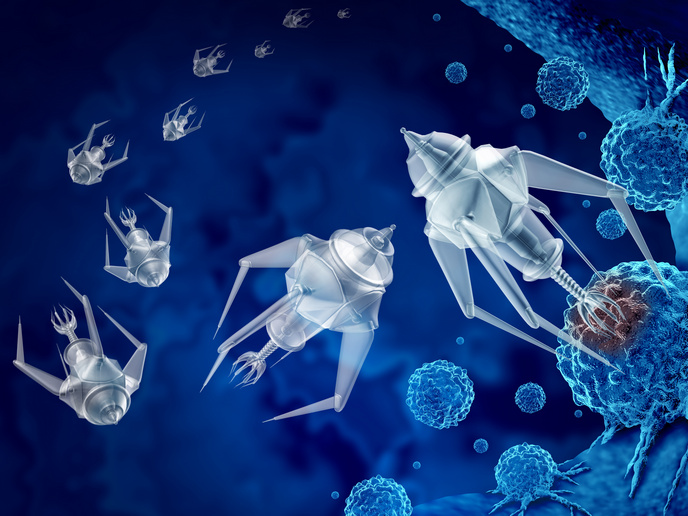
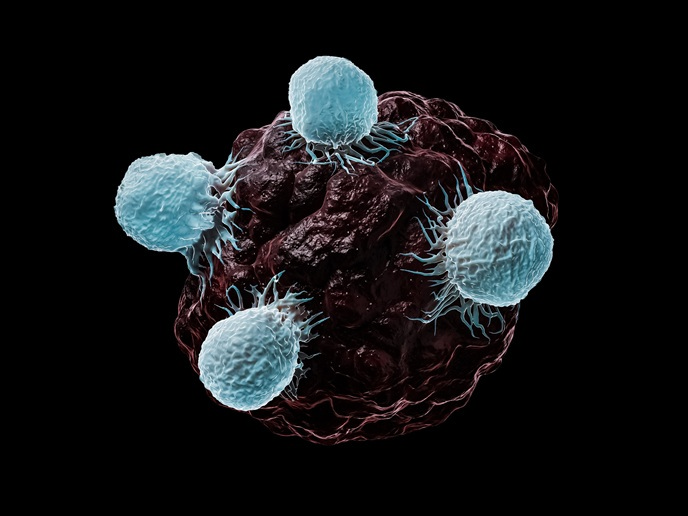
Nanodevices for drug delivery

An effective drug-delivery nanodevice requires that NPs be site-specific and stimuli-responsive with good drug-loading capacity, controlled drug-release capability, biodegradability and biocompatibility. Under an EU-funded initiative, the CAMLC10 project, a drug-delivery nanodevice was developed with large drug-loading capacity and controlled release capability. To begin with, bare magnetite (Fe3O4) NPs with strong paramagnetic properties were first synthesised to ensure remote triggering capability using an external magnetic field. The Fe3O4 NPs were then coated with substances like cetyltrimethylammonium bromide, oleic acid and iron oxyhydroxide (FeOOH) to endow hydrophilicity. Coating with mesoporous (pore size 2–50 nanometres) silica (SiO2) will ensure uniform pore diameter, large surface area, high stability and ability to be functionalised. Outer coating with mesoporous SiO2 was achieved using a sol-gel process. The SiO2-Fe3O4 NPs with decomposable inner shell of FeOOH were functionalised using either a double-layer–structured ligand configuration or a covalently grafted ligand configuration. Such NPs can then be endowed with high specificity to the target site by grafting selected nanocomponents such as ligands, surfactants or peptides. Project work also involved several studies to assess performance of the NPs in terms of drug-holding capacity and controlled release. For testing purposes, the drug gentamicin sulphate was loaded into these nanodevices and drug release was assessed by varying relevant parameters. The parameters changed included pH, pore sealing and stirring speed. Pore sealing is an important attribute as it ensures that the drug remains inside the NPs during transport to the target site. Biocompatibility is a major safety concern where clinical application is a consideration. In vitro cytotoxicity tests were also conducted. The naked NPs showed minimal cytotoxicity whereas the functionalised NPs showed varying levels of toxicity depending on their size and configuration. CAMLC10 outcomes have laid the foundation for clinical application of mesoporous SiO2 hybrid NP-based nanodevices in drug delivery. However, further research and testing is necessary to ensure biocompatibility, safety and efficacy. Besides cancer therapy, mesoporous SiO2 NPs could also find applications in catalysis, chemical separations, implants, thrombolysis and more.