


Busquin urges Industry council not to cut state aid to research
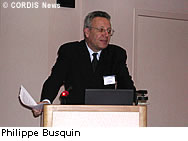
Research Commissioner Philippe Busquin took the opportunity at a briefing on sustainable development in the chemical industry, held at the Solvay research park in Brussels on 20 November, to urge Europe's industry ministers to make an exception for research when reducing state aid to the private sector. Asked by CORDIS News about the use of public/private partnerships as a way of easing the burden on the state, Mr Busquin agreed that these are a good idea, particularly in pre-competitive research. 'Public/private partnerships can focus on a general interest or problem,' he told CORDIS News. 'They give new possibilities to reduce energy consumption and costs, which is of general interest. Our research projects address the common interest,' he said. The Commission's role is to act as a catalyst, said the Commissioner, 'but our contribution is something which comes on top of financing from companies,' he said, adding that he wishes to see a synergy. Mr Busquin also stressed the value of large companies, which often receive less attention than small and medium sized enterprises (SMEs) in discussions on EU funded research. 'SMEs are important, of course, but so are large companies - they bring research along. We don't want to ignore these, especially in the chemical industry, where they have a leading role,' he said. With the Industry council taking place on 5 December, Mr Busquin called on industry ministers to listen to their colleagues in research ministries. 'Industry ministers have understood that a priority must be the stimulation of investment. Of course we must reduce state aid, but there is unanimous agreement in research ministries that state aid should not be reduced here,' he said. 'We should provide tax incentives in this field,' he added. Three projects focusing on sustainable development in the chemical industry were presented at the event. Mr Busquin highlighted the importance of sustainable development, saying that 'the main aim is to develop production methods and high quality materials, with high added value, which are environmentally friendly, safe and not harmful to health.' The Commissioner also pointed out that the European chemical industry is still one of the world leaders, spending nearly six per cent of its turnover on research and development. 'If there is any sector in which we are the global leader, it is this. And we need to maintain that lead, that competitive edge,' he said. The first project presented at the event is named INTINT (an intelligent separation technology). Project coordinator Andrzej Górak explained how the project seeks to combine the chemical reaction and separation processes, thus saving energy, raw materials consumption and costs whilst increasing yields and developing cleaner processes. Some 15 partners, including large companies, SMEs, research institutes and universities from seven countries, including two candidate countries, are working together on the project. The results will be useful for a variety of products, from vodka to complex pharmaceuticals. Mr Górak said that he is convinced that they will be able to apply the results, which will lead to an average saving of up to 20 per cent in operation costs and can be seen as a step towards zero waste. Sylvie Cauvin from the Institut Français du Pétrole presented the second project, CHEM (a new decision support system for chemical/petrochemical processes), which aims to improve chemical plant safety. The project involves partners from six EU states as well as Poland and international cooperation with Japan and the USA, who are providing their own funding. Ms Cauvin said that is a serious industrial accident roughly every three years, costing the industry around 80 million euro. The project hopes to reduce both the number and the gravity of the accidents by providing concise and accurate information to plant operators, thus facilitating decision making. The root of many accidents lies in the complexity of control systems and in the difficulty operators have in making the right decision under extreme pressure in a very limited time. 'The project will integrate tools from leading European companies, universities and research organisations and will help companies to better operate, monitor and supervise processes,' said Ms Cauvin. The SUPERPOL project (supercritical fluids clean up polymer manufacturing) was presented by project coordinator Costas Kiparissides. This new method of producing polymers will reduce energy consumption, pollution and emissions and eliminate organic and aqueous waste streams, said Mr Kiparissides. He added that the new technologies already generated by the project would not have been possible without the European Commission. The new production methods developed by the consortium involve using supercritical fluids. These reduce the amount of toxic waste generated in conventional plastic manufacturing and also result in polymers of exceptionally high purity. These 'fluopolymers' are in great demand in many industries, such as aerospace, and have considerable potential for applications in nanotechnologies, particularly in medical applications of polymeric nanoparticles for targeted drug delivery. SUPERPOL involves universities and leading European chemical companies and promises rapid commercial implementation. 'Companies that can produce the highest grade fluopolymers will control the markets for semiconductors and other applications,' said Mr Kiparissides.