


Fischler praises work of JRC institute in supporting CAP
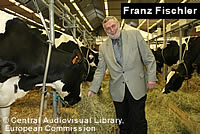
Agriculture Commissioner Franz Fischler says the Joint Research Centre's Institute for reference materials and measurements (IRMM) in Geel, Belgium, plays an essential role in supporting the EU's Common Agricultural Policy (CAP). Speaking during a visit to the institute on 12 July, Commissioner Fischler said: 'The work carried out at Geel is important and makes an invaluable contribution to the smooth working of the CAP.' His comments come shortly after the announcement of EU plans, hotly contended by some Member States, to reform the CAP's 40-year old system of subsidies for farmers and shift emphasis on to the role of farmers in ensuring food safety and animal welfare, and safeguarding the environment. The Commissioner highlighted a key breakthrough made at the institute earlier this month - the development of a new method of testing the gender of beef meat, a valuable tool in the fight against fraud in the European beef market. The EU beef trade is worth billions of euro, with exports and imports of the meat carrying a subsidy difference of 130 euro per 100Kg depending on whether it comes from a female animal or a male, considered to be of higher quality. The IRMM carried out a feasibility study on current methods of gender detection and last month announced that a technique known as polymerase chain reaction (PCR) yields the best results. 'Earlier this month it was possible to have at our disposal a test to determine rapidly and accurately the gender of beef meat,' said Mr Fischler. 'This is an invaluable tool in the fight against fraud and was made possible thanks to the work carried out here at Geel.' The IRMM has also played a key role in boosting research into BSE, or 'mad cow disease.' In 1999, the institute evaluated post-mortem testing for the disease which leads to a breakthrough in the method of detection used. The technique is now used for an EU-wide cattle screening programme covering several million cattle each year. The IRMM is responsible for promoting a common European measurement system by developing, producing and providing reference materials and measurements.