More reliable power through renewable energy

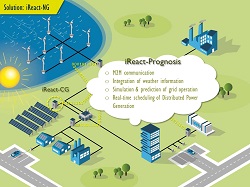
Many countries are promoting a move away from fossil fuels towards renewable energy sources (RES). The increasing amount of electricity stemming from these alternative sources can often cause transmission congestion, which is challenging the way how electricity systems traditionally work. While conventional power plants used to be located close to major demand centres, a great share of RES is often dispersed, located in remote areas far away from large consumption centres. Moreover, their interconnection to the grid can sometimes pose distribution challenges such as step voltage changes and reverse power flow. Distribution system operators burdened with additional costs related to overvoltage and network overload can often pass them on to their customers. A major issue is how to affordably and reliably integrate electricity stemming from RES into existing conventional electricity distribution systems. The EU-funded project iReact-NG has achieved a solution without requesting large customer investments and providing a quick return on investment (ROI). To achieve this, researchers worked on improving their existing iReact product by adding new functionalities that can help get renewable energy into remote communities more cost efficiently. Balancing cost and energy efficiency In addition to the existing standalone iReact automation unit for substation system management, the project team is designing the iReact-CG unit and iReact-Prognosis cloud backend, for integrating power generation systems of isolated or grid-connected microgrids. “The newly developed system ensures optimised operation of all grid integrated resources,” says project manager Georgios Stravopodis. This includes automation and management of different types of power generation sources such as wind farms, PV plants, diesel generators or hydro generators. “iReact-NG offers a very affordable sales model, while the customer enjoys the benefit of an immediate ROI. A very low cost (below EUR 200) recurring monthly license is being offered for each installation node point of the iReact gateway,” explains project manager Georgios Stravopodis. This should make it a highly attractive and sustainable option particularly for people living in remote areas. Monitoring renewable energy transmission The iReact-CG is the interfacing device between the remote monitoring software and the RES. The newly developed iReact-Prognosis is an intelligent system for remote supervision and control of iReact automation controllers and smart-sensors installed in power distribution substations and renewable plants. iReact-NG’s software is based on modular architecture that provides real-time and short-term load prediction, historical data processing, power flow analysis, N-point contingency analysis, grid stability analysis and several other utilities. All software modules are supported by an agent-based framework that provides efficient integration and data abstraction, to easily tailor with customers’ requirements. In addition to the automation unit and the intelligent software developed, the project participant in collaboration with academia, has conducted extensive research on power load prediction using autoregressive models. Also harnessed is artificial intelligence, which is currently making important inroads in the electricity sector to improve power production efficiency and lower maintenance costs. Regression techniques that rely on the use of support vector machines or sparse representation provided improved short-term electrical load forecasting results. EMTech SPACE P.C.’s already existing iReact product has been installed in more than 150 power substations in the Greek transmission grid, handling peak loads near 2 GW, with an average of 8 % power loss reduction and 15 % released capacity. Building on the success of this smart-grid component, EMTECH is developing new components that extend its use from the transmission to the distribution network. Project achievements should help improve power quality in the distribution grid with remote geographical areas being able to sustainably generate their own low-cost energy. Currently, energy prices on Greek islands are typically 100 to 400 % higher than those on the mainland. Project manager Georgios Stravopodis points out, “Smooth cooperation translates to significant amounts of money saved both for the system operator and the citizen alike as it reduces the energy production costs in isolated grids, while also allowing increase of RES penetration.”