


France opens Pasteur Institute in Shanghai
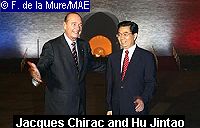
French President Jacques Chirac has opened a Pasteur Institute in Shanghai, during his five-day state visit to China. The new institute, which is a joint operation between the Chinese Academy of Science, the Shanghai town hall and the Pasteur Institute in Paris, will conduct research on endemic and emerging diseases. It will also address the ingredients of traditional Chinese therapeutic remedies, explained Mr Chirac. Its mission 'will lean on the Pasteur Institute's experience in the fields of biomedical research, public health and education in matters of infectious diseases, in particular virology, immunology, epidemiology and vaccinology,' said the Pasteur Institute in Paris in a statement. It will focus on fundamental and applied research on infectious diseases, particularly in the fight against emerging viral infections such as SARS and avian flu, but also on HIV/AIDS, hepatitis, encephalitis, haemorrhagic fevers. The institute could also look into 'the construction of biological resource centres,' explained the Pasteur Institute. 'I have no doubt that this partnership between two world-renowned institutions will be exemplary in every way and that the institutes will be able to conjugate their multiple talents to stop and eradicate these pathologies,' said the French President at the opening ceremony. The new Pasteur Institute in Shanghai will accommodate some 160 researchers within the next three years, and eventually 400. French professor Vincent Deubel, a virus specialist, will be the Institute's director. This will be the first time that a Chinese scientific establishment has been directed by a foreigner. He will be assisted by a Chinese co-director, Professor Zang Jingwu, an immunologist and multiple sclerosis specialist. The institute will be financed by the Chinese authorities and the municipality of Shanghai and by funds provided by French private companies such as LVMH and Areva. During his visit to Shanghai, Mr Chirac also gave an address at the prestigious Tongji University. Speaking to over 400 Chinese students, Mr Chirac explained that France is not only a country of art and culture but also 'a country on the cutting-edge of knowledge and innovation in the high-tech sector'. He then invited the best Chinese students to go to study in France. 'France delivers 7,000 to 8,000 visas to Chinese students every year. This is not enough,' said the president. 'France wishes to welcome a greater number of you in her 'grandes écoles' and universities,' he said, adding that an 'ambitious bursary policy' would be put in place as well as a service centre for Chinese students. 'Thanks to its creative power, its innovative capacity and its industrial reliability, France is a natural partner for China,' continued the French President. 'French enterprises are engaged in all of China's key high-tech areas, representing a huge field of cooperation that our two countries can cover together,' he said. Mr Chirac then reminded his audience that France is also at the forefront of the biggest European technological projects, including the Ariane rocket, Airbus planes and high speed trains, as well as the ITER energy project to realise nuclear fusion. During his visit to China, Mr Chirac also signed science and technology agreements in environmental protection, development and peaceful use of atomic energy, health and medical science and research and the peaceful exploitation of space.
Countries
China, France