


Europe must compete through knowledge in global bio-economy, says Potocnik
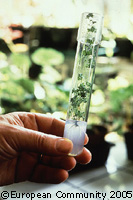
To meet Europe's increasing demand for food, feed, fibres and fuel in a sustainable way, the production of bio-resources from plants, animals or microbes must increasingly be based on knowledge, according to Science and Research Commissioner Janez Potocnik. This assertion is at the heart of Mr Potocnik's vision for a 'knowledge-based bio-economy' - a vision he outlined to participants at an EU conference on the same subject in Brussels on 15 September. 'I understand it as finding ways to maximise the potential of biotechnology for the benefit of our economy, society and the environment,' he said. 'The European bio-economy is a sector of huge importance. There is a common vision and understanding that life sciences and biotechnologies are critical factors for the competitiveness of this bio-economy and for addressing major social and economic challenges,' Mr Potocnik continued. These challenges include a growing demand for healthy, safe food, an increasing risk from diseases such as avian flu, and threats to agricultural and fisheries production from climate change. 'The European bio-economy cannot compete on a global level by delivering only basic agricultural commodities. It must deliver innovations [...] and more of them,' argued the Commissioner. 'Europe must concentrate its efforts on its true strengths if it wants to meet the challenges and make the most of the opportunities of today's global economy in a sustainable way. This is why our true factor of competitiveness lies in our brains and in our creativity. It is 'knowledge ' in the broadest sense of the word.' Creating the knowledge-based bio-economy presents a significant challenge, however. 'The bio-economy is complex and it involves different sciences and technologies, different sectors and industries, it touches upon and involves different policy areas,' explained Mr Potocnik. 'We need to support the convergence of biotechnology and life sciences with other technologies, such as nanotechnologies and information technologies. Linking such policies through multidisciplinary research will have distinct advantages,' he added. Europe benefits from having an excellent scientific, technological and industrial base, and has already taken a leading role in many areas of the bio-economy, from innovative food technologies and animal breeding techniques to environmentally friendly bio products and processes. But good science alone will not be enough to realise Mr Potocnik's vision for the bio-economy. 'All participants in the chain - farmers, industry, regulators and consumers - will need to get together to actually make the bio-economy work [...]. Achieving a common vision among different stakeholders and coherence in policy making is not an easy task!' stressed the Commissioner. 'That is why this conference is especially important in bringing together the different disciplines, stakeholders and policy makers to exchange views and voice expectations.' Finally, said Mr Potocnik, Europe is committed to strong cooperation with international partners to address global challenges, and he revealed that another major international conference on the bio-economy was taking place simultaneously in Beijing. The Commissioner made a joint statement together with Xu Guanhua, Minister for Science and Technology of the People's Republic of China, to the participants of both conferences: 'Although there are many differences between China and the 25 EU Member States, we face many of the same challenges. So naturally, we are looking at the same solutions. We are both very interested in finding solutions that lie in the life sciences and biotechnology, because these are sustainable solutions, that can help us find a balance between the needs of our economies and our environment.' The statement concluded: 'We may learn together and help one another as we seek to find a new way forward to the bio-economy of the future.'
Countries
China