


European astronomers detect a homeless black hole
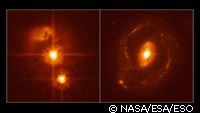
A team of European astronomers, using two of the most powerful astronomical facilities available - the NASA/ESA Hubble Space Telescope and the ESO Very Large Telescope (VLT) at Cerro Paranal, Chile - have discovered a bright quasar without the usual accompanying massive host galaxy. This detection is the most significant result from a joint Hubble-VLT study of quasars, as it represents the first convincing discovery of such an object. One intriguing explanation is that the host galaxy may be made almost exclusively of 'dark matter'. The discovery was reported last week in the journal Nature Physics. Quasars are powerful and typically very distant sources of radiation. They are commonly associated with galaxies containing an active central black hole. The team, made up of astronomers from Belgium, France, Germany and Switzerland, conducted a detailed study of 20 relatively nearby quasars to study the properties of their host galaxies. For 19 of them they found, as expected, that these super-massive black holes are surrounded by a host galaxy. But when they studied the bright quasar HE0450-2958, located some 5,000 million light-years away, they could not find evidence for a host galaxy. Super-massive black holes are commonly found at the centre of the most massive galaxies, including our own Milky Way. These black holes sometimes dramatically manifest themselves by devouring matter from their surroundings. The past decade of observations has shown that quasars are normally associated with massive host galaxies. Observing the host galaxy of a quasar is challenging task because the quasar completely outshines the host and masks the galaxy's underlying structure. To overcome this problem, the astronomers devised a new and highly efficient strategy. Combining Hubble's ultra-sharp images with spectroscopy from ESO's VLT, they observed their sample of 20 quasars at the same time as a reference star. The star served as a reference pinpoint light source that was used to disentangle the quasar light from any possible light from the underlying galaxy. But despite the innovative techniques used, no host galaxy was seen around HE0450-2958. This means that if any host galaxy exists, it must either be at least six times fainter than typical host galaxies, or have a radius smaller than about 300 light-years, i.e. 20 to 170 times smaller than typical host galaxies. 'We must therefore conclude that, contrary to our expectations, this bright quasar is not surrounded by a massive galaxy', said Pierre Magain of Liège University, Belgium. 'With the powerful combination of Hubble and the VLT we are confident that we would have been able to detect a normal host galaxy.' The astronomers did, however, detect an interesting smaller cloud of gas about 2,500 light-years wide near the quasar, which they call 'the blob'. VLT observations show this cloud to be glowing because it is bathed in the intense radiation coming from the quasar, and not from stars inside the cloud. Most likely, it is the gas from this cloud that feeds the super-massive black hole, thereby allowing it to become a quasar. 'The absence of a massive host galaxy, combined with the existence of the blob and the star-forming galaxy, lead us to believe that we have uncovered a really exotic quasar,' said Frédéric Courbin of the Ecole Polytechnique Federale de Lausanne, Switzerland. 'There is little doubt that an increase in the formation of stars in the companion galaxy and the quasar itself have been ignited by a collision that must have taken place about 100 million years ago. What happened to the putative quasar host remains unknown.' The astronomers propose several possible explanations. Has the host galaxy been completely disrupted as a result of the collision? Has an isolated black hole captured gas while crossing the disk of a spiral galaxy? This would require very special conditions and would probably not have caused such a tremendous disturbance of the neighbouring galaxy as is observed. Further studies will hopefully clarify the situation. Another intriguing hypothesis is that the galaxy harbouring the black hole was almost exclusively made of 'dark matter'. It may be that what is observed is a normal phase in the formation of a massive galaxy, which in this case has taken place several 1000 million years later than in most others.
Countries
Belgium, Switzerland, Germany, France