


Research institute lures young dynamic scientists back to Poland
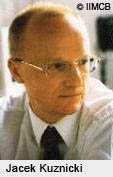
Researchers tempted to move abroad are often young, talented and ambitious scientists who may feel that they cannot further their career in their home country. Offering young scientists opportunities and responsibility at home is a way to tackle this brain drain, and this is exactly what the International Institute of Molecular and Cell Biology (IIMCB) in Warsaw, Poland, has done. It is already reaping returns. 'It's worth investing in young people and giving them independence. If we do this, they can quickly succeed in science, and in winning contracts,' the director of the IIMCB, Professor Jacek Kuznicki, told CORDIS News. The institute is unique in a number of ways, its director explained: it does not offer permanent employment, but contracts based upon regular assessment; lab leaders do not need a habilitation (the qualification required to become a professor in Poland and many other countries); and it is international in nature. It also has a very high number of young scientists heading up research teams. The IIMCB comprises eight research groups addressing different aspects of molecular and cell biology and biomedicine. All lab leaders are selected during an international competition supervised by an independent international advisory board. The winners receive a five-year research professor contract with no formal teaching obligations, two positions for lab members, a furnished laboratory and office space, and access to all of the institute's laboratory equipment and facilities. They also benefit from administrative support, including assistance from the Grants Office. Project operating costs are not covered, and lab leaders are expected to raise external funding for their research and for hiring additional team members. Each lab is evaluated every three years by external experts identified by the advisory board. If the review is positive, a contract for a further three years is offered. If the review is negative, the lab is closed. So far the institute has been very successful. It currently has 64 members of staff, and has published over 200 articles since 2000. According to Professor Kuznicki, the number of very good papers published is also increasing - 38 have now been published in the leading Journal of Biological Chemistry. The IIMCB is also winning an increasing number of research grants, including seven EU projects under the Fifth Framework Programme (FP5), and six FP6 projects. On paper the IIMCB looks, as its director claims, to be a huge success. But what do the researchers themselves think? Dr Janusz Bujnicki is 30 years old, and has already won enough funding to establish a research group of more than 20. Moreover, he returned to Poland from the US to complete his PhD at the institute, having been offered the position of senior research assistant. Dr Bujnicki outlined three factors that contributed to his decision to work at the IIMCB: 'Rumour had it that IIMCB was a unique institute in Poland, keen on employing young and dynamic people. Second, I was offered a salary that was lower than what I was receiving in the US, but still was much higher than a salary of a postdoc at a typical Polish university. Third, I was offered the independence of a postdoc regardless of the fact that I did not even have a PhD yet. I knew it was very difficult to obtain any research position in Poland and I was convinced that such opportunity would not happen again. I took that offer and I think it was one of the best decisions in my life.' In 2002, Dr Bujnicki then became a group leader, heading the Laboratory of Bioinformatics and Protein Engineering. He remains committed to the IIMCB and to Polish research. 'I am staying here because I still believe that IIMCB is incomparable to any other research institute in Poland (and perhaps in the whole of Central-Eastern Europe) in terms of organisation, but also in the atmosphere. I also believe that by staying in Poland I can make a difference.' Dr Marta Miaczynska is another talented researcher lured back to Poland from abroad by the IIMCB. 'I decided to return to Poland because the IIMCB is a unique institution in our country. If I had not got a position here, I would not have returned, as I was not considering any other position in Poland,' she told CORDIS News. Her three previous research positions had been in Austria and Germany, but she was attracted by the idea of building up a cell biology laboratory from scratch and so took up the lab leader position in 2005. Dr Bujnicki believes that much more should be done for young scientists. He knows of other national and international programmes that are aimed at encouraging young and dynamic researchers to return to their home country, but claims that there is not enough money in the system to maintain this support once start-up grants have been spent. 'I am convinced it would be much better if some of the funds currently used for start-up grants were used for competitive grant renewals for young group leaders who proved themselves excellent in the first few years, but still have not yet established themselves well enough to secure funding that would be sufficient to maintain a group,' he says. He also emphasises that support should go beyond funding. The key to a successful career is to have a good mentor, he believes. He describes this mentor as 'a senior scientist who will show you the possibilities and warn of dangers, and share the knowledge that comes with experience'. Dr Bujnicki did not have a mentor until he joined the IIMCB, and he is now trying to pass on some of what he has learnt to his more inexperienced team members, 'many of whom certainly dream of a successful career in science, something I hope I will be able to prepare them for'. The advantages of a system of constant evaluation are obvious for the institute - it means that the directors can be confident that they really have the best of the best working for them. But what of the researchers themselves? Surely the system leads to a sense of insecurity? Professor Kuznicki concedes that the IIMCB does not get a lot of applications from senior scientists, and that those younger scientists that are put off by the regular evaluations tend to apply to work under young investigators elsewhere. 'This label is enough for them,' he says. The two researchers contacted by CORDIS News were also very positive about the system. 'Of course, from a personal point of view, it would add a feeling of extra security to have a tenure, but I prefer such a merit-based evaluation system with clear rules than an unclear system of promotions based on personal connections or non-scientific grounds which one can sometimes encounter elsewhere,' says Dr Miaczynska. Dr Bujnicki speaks even more favourably in support of the evaluations: 'I am not at all concerned by the lack of security. I am actually concerned by the fact that the typical European attitude puts more emphasis on security than the quality of work. I believe this is the main reason for the increasing gap between the quality and quantity of research in the US and in the EU,' he says. He refers to the rules as 'harsh but transparent', and adds: 'I like the challenge and the responsibility and I appreciate that as a result I have an opportunity to work with some of the best scientists in this country.' In addition to the Polish-born researchers that the IIMCB has in its laboratories are a number of foreign researchers. Professor Kuznicki admits that it is difficult to judge how well know the institute is outside of Poland, and also that his country has some way to go before scientists add the country to their preferred list of research locations. He is however optimistic about the future. 'Poland is not yet considered as attractive for a scientific career in western Europe. But I look forward to changing this.'
Countries
Poland