


Seminar looks into Finland's R&D funding toolbox
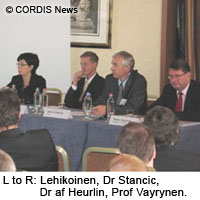
A seminar on the latest Finnish and EU instruments for creating a prosperous research and development (R&D) and innovation environment took place on 10 November in Brussels. The seminar was kick-started by Anita Lehikoinen, Director of the Department for Education and Science Policy at the Finnish Ministry of Education. She spoke of Finland's higher education strategy as a prerequisite for the country's performance in R&D and innovation, and the need to internationalise the country's research structure. The challenge of 'internationalisation' was also echoed by Professor Raimo Vayrynen, President of the Academy of Finland. He pointed to recent efforts by the Academy and Tekes - the Finnish Funding Agency for Technology and Innovation -to bring the Finnish research system into the global arena. One such attempt is with the newly launched Distinguished Professor Programme (FiDiPro). The programme aims to make it possible for universities and research institutes to invite high-quality foreign researchers to work in Finland in order to bring a valuable new international dimension to research. The new programme also seeks to raise the level of scientific and technological knowledge and know-how in Finland by supporting research-driven profiling of universities and research institutes and creating new kinds of international cooperation between university-based research and business companies. It differs from other national funding instruments in that the applicants are universities and major research institutes, rather than research teams or individual scholars. Another funding tool which is expected to make an impact on the country's R&D performance is the new Strategic Centres for Science, Technology and Innovation (CSTI), as outlined by Dr Martti af Heurlin, Deputy Director General of Tekes. The centres will be established in Finland in future competence areas for business and society. In the first stage, centres are planned on the following subject areas: energy and environment, automation and mechanical engineering, health and well-being, forestry cluster and information and communication industry and services. He highlighted the new forestry cluster as an example of one CSTI which was progressing well and would be launched in the beginning of 2007, thanks to the commitment of forest, chemical and machinery companies and universities and research institutes. Also discussed during the seminar was the development of research infrastructures at EU level. Following the recent publication of the European Roadmap by the European Strategy Forum on Research Infrastructures (ESFRI), the European Commission is preparing to implement the 35 major infrastructures projects to be built or upgraded as part of the Seventh Framework Programme programme. Dr Zoran Stancic, the Deputy Director General at the Commission's Research Directorate General, said that for construction, Community support could take the form of facilitating loans through the new Risk Sharing Finance Facility, to be managed by the European Investment Bank (EIB). Still within FP7, Dr Stancic talked of the real novelty of the European Research Council (ERC) as it would offer a pan-European mechanism to support frontier research. The ERC will be wholly investigator-driven and 'bottom-up' in nature. So, instead of relying on political or thematic priorities, the focus will be on supporting the highest quality research from all disciplines by funding individual teams in open competition, solely on the basis of excellence. The dialogue between the ERC and the national research funding bodies should also be a positive evolution for the European Research Area, said Dr Stancic.
Countries
Finland