


How earthworms literally turn the earth upside down
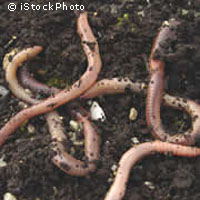
Researchers in the Netherlands have linked Charles Darwin's groundbreaking work on evolution to one of his less well-known research interests: earthworms. Writing in the journal Trends in Ecology and Evolution, the researchers from the Netherlands Institute of Ecology explain how burrowing animals like worms played a key role in the so-called Cambrian explosion 540 million years ago, when many new forms of life arose. Their work was funded in part by the EU-funded MarBEF (Marine Biodiversity and Ecosystem Functioning) project. Charles Darwin was fascinated by earthworms for much of his life, and he carried out numerous experiments on them, including getting his son to play the bassoon to them to see if they could hear. His last book, published in 1881, Prof Darwin explained how earthworms and other soil-dwelling animals were responsible for the formation and functioning of soils. 'Darwin's book taught the general public about the importance of soil organisms,' said Filip Meysman of the Centre for Estuarine and Marine Ecology, who led the research. 'Until then earthworms and similar were seen as vermin to be exterminated.' Yet despite the book's public acclaim, scientists paid little attention to this area of the professor's work until the later part of the 20th century. It is now well established that 'bioturbation' (the reworking of soils and sediments by living things, such as burrowing animals) has an immense influence on our landscapes. On land, these 'ecological engineers' produce soil by breaking down, eroding and transporting bedrock. Burrowing activities also loosen soil and so make it more prone to erosion. 'Over longer timescales, this leads to a smoothing of the landscape, flattening hills and filling up valleys, resulting in an increased sediment transfer by rivers from the land to the oceans,' the researchers write. In the oceans, scientists are increasingly coming to recognise the role of bioturbation in transporting sediments and roughening the surface of the ocean floor, something which impacts the hydrodynamics of the water above the sediments. So what does this have to do with evolution? Before the Cambrian explosion, most of the ocean floor was covered with mats of microbes. As new life forms arose in the Cambrian era, new ways of life arose too: predation meant there was pressure on prey animals to evolve defence systems, such as bristles, spines and shells, while the predators evolved weapons to counter these. The prey animals also looked for ways to hide from the predators, and soon they were burrowing into the ocean floor. Unsurprisingly, the predators following, and soon the subterranean community was born. 'The ocean floor changed drastically: it was a real 'burrowing revolution',' explained Dr Meysman. 'The stable microbial mats of the Precambrian disappeared and in their place came the churned up ocean floor that we know. The sediment dwellers of the ocean had to adapt to this new world. Bioturbation was a driving force for fast evolution, and in this way both of Darwin's books come together.'
Countries
Netherlands