


EU project issues guidelines for scientists on communicating with the media.
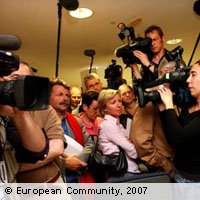
A new set of guidelines designed to help scientists communicate effectively with the media has been drawn up by the EU-funded MESSENGER project. It is widely agreed that if members of the public are to engage meaningfully in scientific debates, they need to be informed. It is also acknowledged that most people follow the latest science news not through peer-reviewed journals, but via the popular press and television programmes. The aim of the guidelines is to help scientists communicate their research results to a wider audience, while avoiding the potential pitfalls of working with the media. A media review by the project partners, the Social Issues Research Centre and the Amsterdam School of Communications Research, revealed that most science coverage in Europe is both accurate and informative. However, there have been cases where research results have been hyped, or simply misinterpreted by journalists, leading in some cases to widespread public anxiety. A good example of this is the case of the MMR (measles, mumps & rubella) vaccine in the UK; a physician's comments in a press conference suggesting that the vaccine was linked to autism and Crohn's disease lead to widespread public concern about the safety of the vaccine, to the point that many parents refused to let their children be vaccinated. The first piece of advice in the guidelines simply encourages scientists to pay attention to how their field is portrayed in the media, and in particular whether any issues are highlighted as cause for concern. The project partners also recommend that scientists take advantage of opportunities to get to know journalists and increase their understanding of how the media works. A large part of the guidelines is dedicated to the communication of risks and benefits. 'To a scientist a risk is simply the statistical probability that an event will occur multiplied by the hazard presented by that event,' the authors write. 'This is not, however, the way that ordinary people, and even scientists when 'off duty', think about risk.' The guidelines recommend that risks and benefits should be stated meaningfully, with absolute risks clearly stated so that increased risks can be properly understood. Furthermore, risks may only apply to a small group of people, and there may be benefits which outweigh the risks. Here the authors give an example of a drug which, when taken in very high doses, can lead to an increased risk of heart attacks. In the media, the scientist in question was careful to highlight that the risk only applied to people taking unusually high doses, and very often these people were in such great pain that for them, the small increase in the risk of having a heart attack was outweighed by that fact that the drug dramatically improved their quality of life. The report also recommends that scientists talk to their institution's press and communications officers prior to communicating with the media. 'Many of these have a journalism or public relations background and often have useful insights into the way the media operate,' the authors write. 'Their experience can be invaluable when preparing material for popular dissemination and should be used at every opportunity.' Ultimately, the project partners hope that their work will lead to increased trust in scientists. 'European citizens' faith in scientists remains high, but it is not unconditional,' they warn. 'The route to trust is through better communication, together with increasing engagement and dialogue between the science communities and civil society - a process in which the popular media have a critical part to play.'
Countries
Netherlands, United Kingdom