


European consortium enters the ring with multimedia search engine
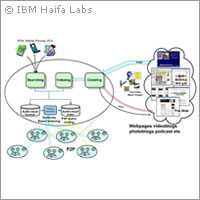
A European consortium of nine partners from academia and industry is developing a large-scale, distributed peer-to-peer architecture that will make it possible to search audio-visual content using the query-by-example paradigm. In this paradigm, a musical piece is used as a query and the result is a list of other musical pieces ranked by their content similarity. Dubbed SAPIR, for Audio-visual content using Peer-to-peer Information Retrieval, the €3.8 million project is being funded under the Sixth Framework Programme (FP6) and will involve building a large scale information community that will make multimedia more accessible. 'Today's popular search engines work within defined boundaries,' explained Yosi Mass, project leader for SAPIR at the IBM Research Lab, Haifa, Israel. 'Sapir's goal is to establish a giant peer-to-peer network, where users are peers that produce audiovisual content using multiple devices and service providers are super-peers that maintain indexes and provide search capabilities,' he added. As a search engine for audio/visual content, SAPIR will explore new ways to analyse, index, and retrieve the vast amounts of speech, image, video, and music currently filling the digital universe. 'Defining new standards in search methods, SAPIR will incorporate technologies such as voice recognition, image processing, indexing algorithms, sophisticated ranking mechanisms, and real search in audio-visual content. Searching by example rather than text-based queries will allow users to say a word out loud and have the engine look for a similar speech pattern. Another scenario would mean anyone could input a picture of a saxophone and have the engine search for similar shapes' said Mr Mass. The end result will be a peer-to-peer distributed space that can be searched by content or example rather than using the current methods, which are limited to keywords and text-based tags. 'SAPIR will address some of today's most exciting search challenges, starting with the scale of information being addressed. The searchable space created by the massive amounts of existing video and multimedia files greatly exceeds the area searched by today's major engines. The popularity of new video sites is a clear indication of today's vital need to search for multimedia. The massive scale of this data can no longer be handled by the current model of centralised crawling and indexing of all searchable content' added Mr Mass. The SAPIR consortium includes experts from industry and academia, each bringing their expertise in the area of multi-modal devices, information retrieval, indexing, peer-to-peer distribution, and audio-visual analysis and social networking. 'Today, the highly scalable search for media-rich information remains an open arena. One of the keys to giving users a comprehensive search experience is breaking down today's limitations of text-based searches and bounded search spaces,' concludes Mr Mass. In fact, the SAPIR project is one of many European efforts to develop a new generation search engine to compete with the world's most popular search engine Google and its direct rival Yahoo!. A French project, labelled 'Quaero' after the Latin 'I search', was created in 2005 with the aim of giving Europeans a more local search medium for multimedia content. Meanwhile, a German project dubbed 'Theseus', after the mythological king of Athens who found his way out of the Minotaur's maze, is taking a different approach by focusing on text-based searches. Whether the winning search engine will be American or European, focused on text-based or multimedia searches, the race for pre-eminence in this field of innovation could be one of the most interesting information and communication technology shows of the decade.
Countries
Israel