


Drilling starts on pilot CO2 storage site
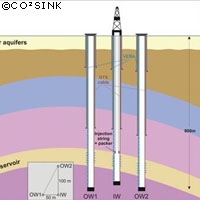
Drilling has started on an underground test storage facility for CO2 (carbon dioxide) near the German town of Ketzin, west of Berlin. During the next two years, some 60,000 tonnes of CO2 will be injected into a saline aquifer where it will be stored at a depth of over 700 metres underground. The start of the drilling marks an important milestone for the EU-funded CO2SINK project, which aims to increase our understanding of what happens when large amounts of carbon dioxide are injected into an underground reservoir. The project partners hope that the pilot project in Ketzin will provide them with important information on the injection technology, the safety of CO2 storage and possible long-term risks and costs. 'The storage of this greenhouse gas can represent an option to gain more time for the development and introduction of CO2-free technologies. However we have to know: what processes are set off through underground storage and what happens in the medium and long term to CO2 that is stored underground? That is what we want to investigate,' explained Rolf Emmermann of Germany's GeoForschungsZentrum Potsdam, which is coordinating the project. The geology of the project site has been studied for years and it is known that it is well suited for the underground storage of CO2. Furthermore, the existing infrastructure at the surface reduces the need for new developments and the project also benefits from the strong support of the local politicians and authorities, who have played an active role in the project definition. During the two-year experiment, the area will be continuously monitored from the surface to deep underground. Among other things, probes will be lowered into the bore holes to study the properties of the rocks at different depths using three dimensional techniques similar to ultrasound technologies found in the medical field. 'We will use the entire methodical arsenal of the geological sciences to gain a comprehensive picture of the processes taking place, because the significant aspect is the long term safety of such a storage facility and the corresponding development of the necessary surveillance technologies,' said Professor Emmermann.
Countries
Germany