


Frattini emphasises cooperation at security research meeting
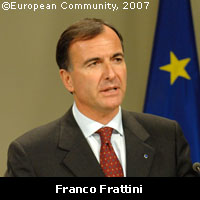
The importance of cooperation at all levels was emphasised by EU Justice, Freedom and Security Commissioner Franco Frattini at the inaugural meeting of the European Security Research and Innovation Forum (ESRIF). ESRIF is intended to foster a public-private dialogue on security research by bringing together all relevant stakeholders. Together, forum participants will make proposals for a strategic security research and innovation agenda identifying needs and priorities. They will also share ideas and best practices in order to make optimum use of existing capabilities and funding instruments. 'By ensuring the connection between security research and security policy-making, ESRIF will contribute to delivering more effective policies and ultimately better security to EU citizens,' says the European Commission. The single ESRIF plenary will involve between 50 and 70 people representing all stakeholders in security research. A number of working groups with 200 to 300 contributors will also be established, focusing on specific topics. The forum will present a Joint Security Research Agenda towards the end of 2009. Speaking at ESRIF's first meeting, Mr Frattini emphasised the importance of basing security policies upon solid research. The EU has already taken steps in this direction by introducing the theme of 'security' to the Seventh Framework Programme (FP7) for research, and providing it with nearly €1.5 billion. An additional €750 million is also available to improve security within the Community and support the work of Member States. 'This funding is crucial if we are to meet long-term security challenges. We must face the changing nature of security threats. These threats use sophisticated technology and cross traditional borders,' said Mr Frattini, adding that the law enforcement community must be able to fight this new technology with innovative technological tools of their own. Ensuring that these tools outperform those of terrorists, more research is required. Mr Frattini announced that a forthcoming action plan on the security of explosives and detonators will be supported by research. 'Many experts are taking the time to come to Brussels and discuss these issues with us. This demonstrates that there is an interest to work together,' he said. The EU is already funding security-related research in several areas. The Commissioner spoke of his own experiences at London's Heathrow and Amsterdam's Schiphol airports, where officials examined his eye instead of his passport. Planning is also underway for a raft of new projects under FP7. Some 44 projects will receive €156 million between them following the first call for proposals. Contracts are yet to be signed, but forthcoming projects are expected to address topics such as: a mobile device to detect the home manufacture of threatening substances; protecting water networks with automatic surveillance systems; security for large-scale public events; creating a ballistics database; crisis management; and the video detection of abnormal behaviour in a crowd. Meanwhile in Germany, international experts are participating in a week-long meeting on research to protect society from new threats. Germany introduced its own security research programme in March, and the first round of projects has already been selected for funding. The projects will share funding of €50 million.
Countries
Germany