


EU project taking CO2 out of the atmosphere
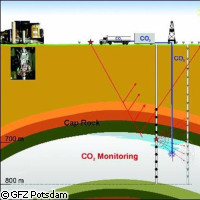
'The European Commission is committed to encouraging industry to reduce its carbon dioxide (CO2) emissions and research plays a vital role in that,' said the European Science and Research Commissioner, Janez Potocnik. The accumulation of CO2 is considered to be the main cause of climate change. However, the EU-backed project CO2SINK, with financing to the tune of EUR 8.7 million, aims to reduce greenhouse emissions through CO2 sinks - in other words - storing it underground. Under the Kyoto Protocol, EU countries have committed themselves to reducing their emissions of CO2 by 8% during the period 2008 to 2012. There are many options available and the EU is pursuing a multi-pronged strategy to achieving this goal. CO2 capture and geological storage however, seems to be the only solution that has the potential to achieve substantial reductions in a cost effective manner over the next few decades. And the CO2SINK project is at the forefront of developing the appropriate technologies to achieve CO2 storage. The CO2SINK integrated project is supported by FP6 and aims to develop the basis for CO2 capture and geological storage. This will be achieved by injecting CO2 into a saline aquifer near the town of Ketzin, west of Berlin. Up to 60 000 tons will be stored at a depth of more than 600 meters during the next 2 years. CO2SINK aims to make full use of the physical properties of CO2 and the changes it undergoes at extreme pressures. At the pressures encountered deep underground, CO2 is dense and behaves more like a liquid than a gas. What this means is that large quantities can be stored in a relatively small volume. Most of what is stored in this manner occupies the spaces in porous rock. This technology is not all that new as the oil and gas industry have been using underground storage for many years once they discovered that injecting CO2 into oil fields can enhance oil recovery. CO2 is even being deliberately stored in a salt-water reservoir under the North Sea for environmental reasons. Other geological storage schemes are under development, and plans to monitor them are well advanced. Once the CO2 has been captured, it can be stored securely for hundreds or even thousands of years. Major reservoirs suitable for storage have been identified under the earth's surface and in the oceans and several scientific projects are currently exploring how to develop these options. To allay public fears over the safety of the project, numerous safeguards have been put into place. These include two observation wells which have been successfully lowered to depths of 800 meters. These have been equipped with the most modern sensor technology. The safety of the underground store is supported by extensive survey reports. Meanwhile, to guarantee the safety of storage, the State Office for Mining, Geology and Minerals of Brandenburg (LBGR) have supported the project in technical and safety-related issues during the prospecting, development and examination of the storage location Ketzin, and have issued the required legal mining-authorisations. Any leakage at the Ketzin site is highly unlikely. The risk of a sudden, large-scale release of CO2 has been avoided using the same precautions that are applied to handling other gases, such as avoiding unsuitable or geologically unstable sites. The geology in the area surrounding Ketzin is very stable. There are many ways in which CO2 emissions can be reduced, such as increasing the efficiency of power plants or by using natural gas instead of coal as fuel. Unfortunately however, most of these scenarios suggest that these steps alone will not achieve the required reductions in CO2 emissions. The capture and storage of CO2 from fossil fuel combustion could play an important part in solving this problem. Decarbonising the use of fossil fuels, by capture and storage of CO2, would help the transition to a future carbon-free energy system.
Countries
Germany