


Europeans reveal smoking gun in cosmic ray acceleration efficiency
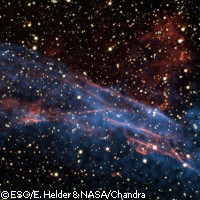
Astronomers recognise that cosmic rays - high-energy atomic nuclei (mostly protons) travelling through space at close to the speed of light that hit the Earth's atmosphere - have enough energy to produce defects in electronic components. New research, published in the journal Science, shows that galactic cosmic rays emerge from within the Milky Way, the galaxy containing our solar system. The protons, which move at the Universe's 'ultimate speed limit', have been accelerated to energies that surpass those generated by the Swiss-based Large Hadron Collider at CERN (European Organization for Nuclear Research). 'It has long been thought that the super-accelerators that produce these cosmic rays in the Milky Way are the expanding envelopes created by exploding stars, but our observations reveal the smoking gun that proves it,' explained lead author Dr Eveline Helder of the Astronomical Institute at Utrecht University in the Netherlands. For his part, Dr Jacco Vink, also from the Astronomical Institute, said: 'You could even say that we have now confirmed the calibre of the gun used to accelerate cosmic rays to their tremendous energies.' Drs Helder and Vink, along with their colleagues, succeeded in determining whether or not stellar explosions generate enough accelerated particles to explain the number of cosmic rays that strike the Earth's atmosphere. Not only are the accelerated particles major components of this process, but the astronomers also worked out how much energy is removed from the shocked gas in the stellar explosion and used to accelerate particles. 'When a star explodes in what we call a supernova, a large part of the explosion energy is used for accelerating some particles up to extremely high energies,' Dr Helder pointed out. 'The energy that is used for particle acceleration is at the expense of heating the gas, which is therefore much colder than theory predicts.' In order to shed light on this mystery, the team investigated the remnant of a star that exploded in 185 AD that was recorded by Chinese astronomers. Called RCW 86, the remnant is located some 8,200 light years away towards the Circinus (the Drawing Compass) constellation. Researchers believe it is probably the oldest known record of the explosion of a star. The team used the European Southern Observatory's (ESO's) Very Large Telescope to measure the temperature of the gas right behind the shock wave produced by the stellar explosion. The researchers also measured the speed of the shock wave by using images obtained with the US-based National Aeronautics and Space Administration's (NASA) X-ray Observatory Chandra three years apart. According to them, it moved at a speed of between 10 million and 30 million kilometres per hour, and between 1% and 3% of the speed of light. They also measured the temperature of the gas to be 30 million degrees Celsius. While the temperature is very hot compared with what we are accustomed to by everyday standards, the team said it is way below what they anticipated. Because of the velocity of the measured shock wave, the researchers believed the gas should have been heated to at least 500 million°C. 'The missing energy is what drives the cosmic rays,' Dr Vink summed up.
Countries
Netherlands