


Ancient barley DNA could lead to new varieties
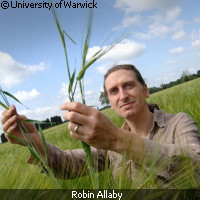
UK scientists have extracted DNA from 3,000-year-old barley grains from Egypt's Upper Nile region. A genetic analysis of the grains sheds light on ancient farming methods and could aid in the development of new crop varieties that are able to survive climate change. The findings are published in the journal Public Library of Science (PLoS) ONE. Barley was the first crop to be domesticated, and 7,000 years ago it was being grown throughout Europe and north Africa: from Scandinavia in the north to Egypt in the south. Its popularity with the earliest farmers can be attributed to its rapid growth and ability to thrive in different conditions. The barley in this study was recovered from the Qasr Ibrim site, which lies between the first and second cataracts of the Nile. In ancient times, this area lay on the boundary between the Roman and Nubian empires, and over three millennia it was occupied by five different cultures: Napatan, Roman, Meroitic, Christian and Islamic. Barley crop cultivation in this region was part of all these cultures. At first glance, the barley grown at Qasr Ibrim looks like wild barley, as only the central florets of the plant had grains (this is known as 'two-row' barley). This is surprising, because a six-row version of barley was being cultivated in northern Egypt 8,000 years ago. In six-row barley, both the lateral florets and the central floret bear grains, making the plant much more productive. The successive cultures living at Qasr Ibrim must have had access to six-row barley, so why did they persist in growing an apparently more primitive, less productive variety of the crop? The mystery deepened when the scientists analysed the DNA of the ancient barley. They found that far from being a wild form of barley, the Qasr Ibrim barley was actually descended from a six-row variety (it still had the gene causing the six-row appearance), but some kind of genetic mutation had caused it to revert to a two-row variety. This is the first time scientists have found a two-row variety that developed from a six-row ancestor in this way. Because six-row barley produces more grains, under normal conditions it would be expected to out-compete two-row barley. The fact that two-row barley dominated for so long, and was adopted by all the cultures that settled in the area, suggests that the two-row barley must have had a major advantage over the six-row variety. 'There may have been a natural-selection pressure that strongly favoured the two-row condition. One such possible cause we are currently investigating is water stress,' commented Robin Allaby of the University of Warwick in the UK. 'Qasr Ibrim is located in the upper Nile, which is very arid relative to the lower Nile where six-row remains are found, and studies have shown that two-row can survive water stress better than six-row.' The researchers suggest that new cultures initially may have tried growing six-row barley upon arriving in the region, but then adopted the preceding culture's two-row barley when they saw that it grew better in the local conditions. 'This finding has two important implications. Such strong selection pressure is likely to have affected many genes in terms of adaptation. Archaeogenetic study of the DNA of such previously lost, ancient crops could confirm the nature of the selection pressure and be very valuable in the development of new varieties of crops to help with today's climate change challenges,' commented Dr Allaby. 'Secondly, this crop's rediscovery adds to our respect for the methods and thinking of ancient farmers. These ancient cultures utilised crops best suited to their environmental situation for centuries; rather than the much more popular six-rowed barley, they used a successful low-grain-number yield crop which could cope far better with water stress.'
Countries
United Kingdom