


New fossil finds shed light on fluctuations of Arctic sea ice over past 30,000 years
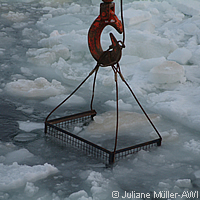
A team of partly EU-funded scientists has now successfully reconstructed a clear timeline for fluctuating sea-ice conditions in the Fram Strait between Greenland and Spitsbergen over the past 30,000 years. The research, published in the journal Nature Geoscience, improves scientists' understanding of climatic changes before human activities started having an impact. The research was in part funded by the European Research Council (ERC) in the framework of an ERC Starting Grant. The project, entitled ICEPROXY and worth nearly EUR 1.9 million in funding, is dedicated to finding 'Novel lipid biomarkers from polar ice: climatic and ecological applications'. The analysis of a sediment core from the northern part of the passage showed that, over time, the Fram Strait ice cover underwent considerable changes. 'Our reconstructions of the various ice conditions show how drastically the Arctic reacts even to short-term climate fluctuations,' says lead author Juliane Müller of the Alfred-Wegener-Institut (AWI) für Polar- und Meeresforschung in Germany. During the Last Glacial Maximum (LGM) about 20,000 years ago, when sea levels were at their lowest and glaciers at their thickest, the Fram Strait was permanently covered in ice. Then, about 15,000 years ago, a period of global warming left the strait ice-free even during winter months. Over the past 5,000 years, evidence indicates a seasonal change between ice-covered periods in winter and spring, and ice-free phases in summer and autumn. 'Sea ice is a critical component of the climate system: variations in sea-ice cover affect the albedo [extent to which light is reflected] of polar regions, and also the rate of deepwater formation,' the paper reads. 'Changes in the sea ice of the North Atlantic Ocean are thought to have been related to abrupt climate changes throughout the last glacial termination, but reconstructions of sea-ice conditions are rare.' The scientists used two complementary biomarkers to determine the state of sea ice in the strait, analysing specific fossilised algal remains deposited in the sediment layers: the presence of the first biomarker, IP25 (a complex molecule produced by tiny algae (diatoms) living in the sea ice), indicates that the strait was covered in ice. Brassicasterol is the second biomarker, produced by phytoplankton that live in open water. The presence of brassicasterol hence points towards the strait being ice-free. Absence of both, the researchers explain, is proof of permanent ice-cover, since lack of light and nutrients under the thick ice shield would prevent algal growth. If both biomarkers are present, on the other hand, they indicate seasonal change of sea-ice conditions. This new method combining IP25 with other biomarkers could provide more detailed and exact insights into global climate in the past, a scientific field that is attracting increasingly more interest recently. 'Examinations on natural changes of sea ice extent in times when humans had no impact on the climate have become a focus of numerous international research projects in the Arctic,' explains Professor Rüdiger Stein, a geoscientist at AWI. The Fram Strait, a narrow passage between eastern Greenland and the Norwegian island of Spitsbergen, is the only deepwater connection (at about 2,600 metres mean water depth) between the Arctic and Atlantic oceans. Transport of sea ice through the strait has an important influence on global ocean circulation and hence on the global climate.
Countries
Germany, United Kingdom