


Close shave for European Space Agency's four-satellite cluster mission
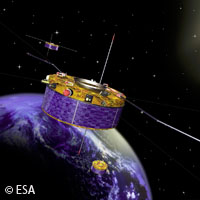
A four-satellite cluster mission that nearly met a sticky end following a technical blip, has now been recovered and put back on the right track thanks to a European Space Agency (ESA) 'dirty hack' - space jargon for a 'non-standard' procedure. The four satellites, which were launched in 2000 from a Soyuz-Fregat rocket launcher at the Baikonur Cosmodrome in Kazakhstan and have been orbiting Earth in a controlled formation ever since, stopped responding to commands from mission control in March. The satellites, which work together and weigh 550 kg each, have matching equipment on board to investigate Earth's space environment and its interaction with the solar wind - the stream of charged particles pouring out from the Sun. The Cluster spacecraft resemble giant 'Lego' sets, assembled from thousands of individual blocks. Each one is shaped like a giant disc, 1.3 m high and 2.9 m wide, with a cylinder in the centre. Among each satellite's 11 instruments, five are devoted to the Wave Experiment Consortium (WEC), which takes important measurements of electrical and magnetic fields. All four sensors must work together to make carefully orchestrated observations - just losing one could seriously disrupt the unique 'four-satellite science' of the mission. So when trouble struck on 5 March as the WEC package on the Cluster's number 3 satellite Samba failed to switch on, anxious mission control operators at ESA's European Space Operations Centre, in Darmstadt, Germany, whipped into action and activated a series of standard recovery procedures. However, none of these measures were successful. To make matters worse, no status information could be retrieved from the instruments. 'With no status data and no response from the instrument, we suspected either that the device's five power switches were locked closed or a failure caused by an electrical short circuit, one of the most dangerous faults on any satellite,' says ESA's Jürgen Volpp, Cluster operations manager. The ESA team, made up of those who had built the satellites, WEC scientists and manufacturers, then spent a painstaking few weeks trying to get to the root of the problem. The answer they had been looking for eventually came thanks to an unlikely tool - some onboard software that had been dormant since just after launch over 10 years ago. Now the team was able to deduce that the problem was not coming from a short circuit as they first suspected but from five power switches that had become locked in the 'closed' position. Although tests carried out in 1995 had prepared for three switches locking shut, no one was prepared for all five clamping shut! Now the team was able to design a recovery procedure and test it on one of Samba's sister satellites. On 1 June they tested out the procedure for real and managed to flip Samba's power switches to 'on' and restart the disobedient WEC process. 'The solution was based on a 'dirty hack' - jargon referring to any non-standard procedure - but we really had no other option,' says Volpp. The Cluster has now returned to operation and the team can breathe a sigh of relief. ESA's Manfred Warhaut, Head of Mission Operations says the team is now learning from this experience and taking measures to prevent such a failure happening again. 'When everything goes as planned, flying a mission can be routine. But when unexpected trouble occurs, and there's nothing in the manuals, you really want to have an experienced and talented team on hand to solve the problem.' In October 2009 the Cluster mission was extended until the end of 2012.For more information, please visit:European Space Agency:http://www.esa.int/esaCP/index.html
Countries
Germany