


EUCYS 2011 winners announced - the scientists of the future are here!
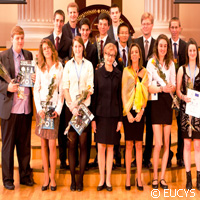
Young scientists from Ireland, Lithuania and Switzerland have scooped the top science prizes at an awards ceremony following a five-day competition for young scientists. The 23rd annual EU Contest for Young Scientists (EUCYS) Finals held in Helsinki, Finland, saw 130 contestants from 37 countries across Europe and beyond come together to show the science world that the researchers of the future are bright and bursting with ideas. Out of 87 project entries an international jury decided that 3 projects in computing, medicine and engineering were in a class of their own and awarded them with the top accolades. The first prize winners were Alexander Amini from Ireland with his project 'Tennis Sensor Data Analysis: An Automated System for Macro Motion Refinement', Povilas Kavaliauskas from Lithuania with his project 'The Role of Houseflies (Musca domestica) in Spreading Antibiotic Resistant Bacteria' and Pius Markus Theiler from Switzerland with his project 'pi Cam - The Development of a Camming Device for Climbing'. The annual contest is open to young people between the ages of 14 and 21, and highlights the EU's commitment to investment in young people by ensuring the scientists of the future are well equipped to face Europe's problems of tomorrow. 'Young, talented researchers will help shape our future. We need to find answers to society's biggest challenges such as climate change, finding sustainable sources of energy, feeding the world or fighting disease. So I encourage young people to follow a career in science and keep Europe world-class in research and innovation,' said Research, Innovation and Science Commissioner Máire Geoghegan-Quinn. The EU Contest Finals act as the final round in a series of stages for the entrants as all the young scientists in the competition are first prize winners from their respective national competitions. The contest was held in Kattilahalli, an old power plant transformed for cultural projects. This year the entrants covered a broad range of topics including biology, chemistry, computing, social sciences, environment, mathematics, materials, engineering and medicine, and aside from the first prize winners, teams from Bulgaria, Germany and the United Kingdom were awarded second place prizes, and third place prizes went to teams from Norway, Poland and the United Kingdom. A special international prize was won by a project from New Zealand. The winners will share EUR 51,500 of prize money. The EU Contest is the successor to the Philips contest, which ran from 1968 to 1988 and brought together national contest winners. The then President of the European Commission, Jacques Delors, was approached in 1987 about the European Commission taking on the running of the Contest and after several consultations it was decided that from then on the Commission would be in charge of the Contest. The first EU Contest Finals took place in Brussels in 1989. Since then, the event has been hosted in Amsterdam, Bergen, Berlin, Budapest, Copenhagen, Dublin, Helsinki, Lisbon, Luxembourg, Milan, Moscow, Newcastle upon Tyne, Paris, Porto, Seville, Stockholm, Thessaloniki, Valencia, Vienna and Zurich. The standard of entries is consistently high, and several past participants have achieved major scientific breakthroughs or set up businesses to market ideas developed for the Contest.For more information, please visit:EU Contest for Young Scientists:http://ec.europa.eu/research/youngscientists/index_en.cfm