


Researchers investigate how breeding birds respond differently to lengthening days
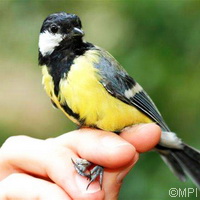
The stretching out of the days as winter draws to a close has long been a cue for birds to start reproductive activity, and in a new study published in the journal PLoS One, researchers from Germany, Sweden and the United States have looked at the internal gene activity in bird brains to get to the bottom of how variation in day length affects birds in different places. It has long been accepted that birds living in the milder climatic conditions of southern Europe usually begin breeding earlier in spring compared to animals living in colder habitats further north. Many species around the world use seasonal information to coordinate their reproductive habits with the conditions in their surrounding environments. However, the exact internal processes and tissues in the brain involved in these responses have remained a mystery to scientists. The team's findings show that variation in day length affects gene activity in the brains of Great Tit (Parus major) populations differently depending on whether they come from central or northern Europe. However, climate change has already started to shake things up considerably: it has triggered warmer temperatures early in spring, meaning day length is less reliable as a signal for spring's onslaught. These warmer spring temperatures also mean the insects the birds need to feed their young are available sooner so the birds have had to change their breeding schedules accordingly. The team's work builds on recent studies of domesticated species like rodents, sheep, goats and quails. These studies successfully identified the genes and the parts of the brain that are involved in the response of an organism to changes in day length. Nicole Perfito from the Max Planck Institute for Ornithology explains how they set out to see if they could do the same for wild species: 'Domesticated species have been bred for commercial purposes, and can breed at almost any time of year. Do wild species, which have to adapt their reproductive cycles continually to the seasonal changes in nature, possess the same mechanisms? And how would such mechanisms allow populations from various habitats to use different day length thresholds to get ready to breed at the right time of year?' To answer these questions the team set out to investigate the activity of genes in the brains of Great Tits from Germany and Sweden. They first exposed the birds in the laboratory to short winter days and then a long summer day. Using highly sensitive techniques, the team was able to establish which genes were activated in the brain during the single long day. Indeed, in the wild birds similar genetic cascades were set in motion compared to a highly domesticated bird, the Japanese quail. This proves that the same physiological processes occur in wild animals as in domesticated ones. The scientists were also surprised to see differences between the Swedish and German Great Tits: whereas the Swedish birds showed a rather strong genetic response to the long summer day, the German birds hardly responded at all. In nature, birds in Sweden lay their eggs about three weeks later than the German birds that live in a more southerly and milder climate. These findings imply that birds breeding up north have a shorter time span for raising their offspring and have to respond more strongly to changes in day length and start breeding faster once a threshold is passed. Paradoxically, birds living further south that can afford longer periods for breeding activities possess a different day length threshold. It is possible that stimulation by a greater number of long days and possibly additional environmental information such as high temperatures is required to change gene activity. For Great Tits, their offspring has to hatch at a time when their main food source (young caterpillars that are small, soft and rich in protein) is highly abundant. However, if warmer temperatures occur food for the caterpillars appears earlier and the caterpillars may have developed too far when a nest of Great Tit hatchlings has the greatest nutritional demand. For southern populations the effects of climate warming might not be as bad because they would be able to adapt more readily. However, birds in northern climes might be more vulnerable to climate change as they appear to rely more strongly on day length cues alone. The researchers are still unsure whether the different responses of the Great Tits result from environmental information from their respective surroundings, or whether they represent an evolutionary adaptation to living at different latitudes. 'In light of the dramatic changes in environmental conditions through climate change we urgently need to increase our understanding of how animals breed at the right time and thus are successful,' says another author on the study, Michaela Hau, also from the Max Planck Institute for Ornithology.For more information, please visit:Max Planck Institute for Ornithology:http://www.orn.mpg.de/en
Countries
Germany, Sweden, United States