


Study shows bacteria forms dolomite
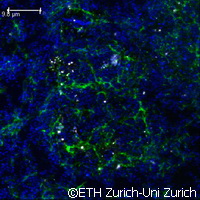
For many years scientists have been investigating how the carbonate mineral dolomite is formed but no concrete results have ever emerged... until now. Researchers in Germany, Spain and Switzerland have succeeded in shedding light on this puzzle, finding that bacteria play a key role in this mineral's formation. The results are presented in the journal Geology. Led by the Cluster of Excellence 'The Future Ocean' and GEOMAR |Helmholtz Centre for Ocean Research Kiel in Germany, the team examined globally distributed marine bacteria that use sulphur compounds instead of oxygen to generate energy (i.e. sulphate respiration). They discovered that primary dolomite crystals are formed under conditions that are currently found in marine sediments. 'The dolomite precipitates exclusively within a mucus matrix, secreted by the bacteria to form biofilms,' explains Dr Stefan Krause of GEOMAR |Helmholtz Centre for Ocean Research Kiel. 'Different chemical conditions prevail within the biofilm compared to in the surrounding water. In particular, the alteration of the magnesium to calcium ratio plays an important role. These changes allow for the formation of dolomite crystals.' But the team went one step further. 'We were able to show that the ratio of different isotopes of calcium between the ambient water, the biofilm and dolomite crystals is different,' adds Dr Volker Liebetrau, who is also a researcher at GEOMAR. 'This ratio is an important tool for us to reconstruct past environmental conditions. The fact that bacteria are involved in this process allows more precise interpretations of climate signals that are stored in rocks.' Despite this new information, however, the researchers say more work needs to be conducted to determine why large-scale deposits from primary dolomite are no longer produced on the ocean floor. What they have found to date is that primary dolomite is formed by a process as common as microbial sulphate respiration under conditions that prevail in the seabed. 'Here we are still faced with a puzzle,' says Professor Tina Treude, head of the Working Group at GEOMAR. 'One possibility is that massive primary dolomite can form particularly during times when large quantities of organic matter in the seabed are degraded by sulphate-respiring bacteria. Such conditions exist when the sea water above the seafloor is free of oxygen. In Earth's history, several such oxygen-free periods have occurred, partly consistent with time periods of intensified dolomite deposition.' Over 90% of dolomite is made up of the mineral dolomite. Researchers became aware of large deposits of primary dolomite as old as 600 million years, and it was first scientifically described in the 18th century. Experts say the process of recent primary dolomite formation is restricted to extreme ecosystems, including bacterial mats in highly saline lakes and lagoons. 'As these systems are very limited in space, there is an explanation gap for geologists for the widespread presence of fossil dolomite,' concludes Dr Stefan Krause, Geomicrobiologist at GEOMAR |Helmholtz Centre for Ocean Research Kiel.For more information, please visit: GEOMAR |Helmholtz Centre for Ocean Research Kiel: http://www.geomar.de/en/(opens in new window) Geology: http://geology.com/(opens in new window)
Countries
Switzerland, Germany, Spain