Recently ended BONUS projects report on widespread impact on policy and management measures in the Baltic Sea region

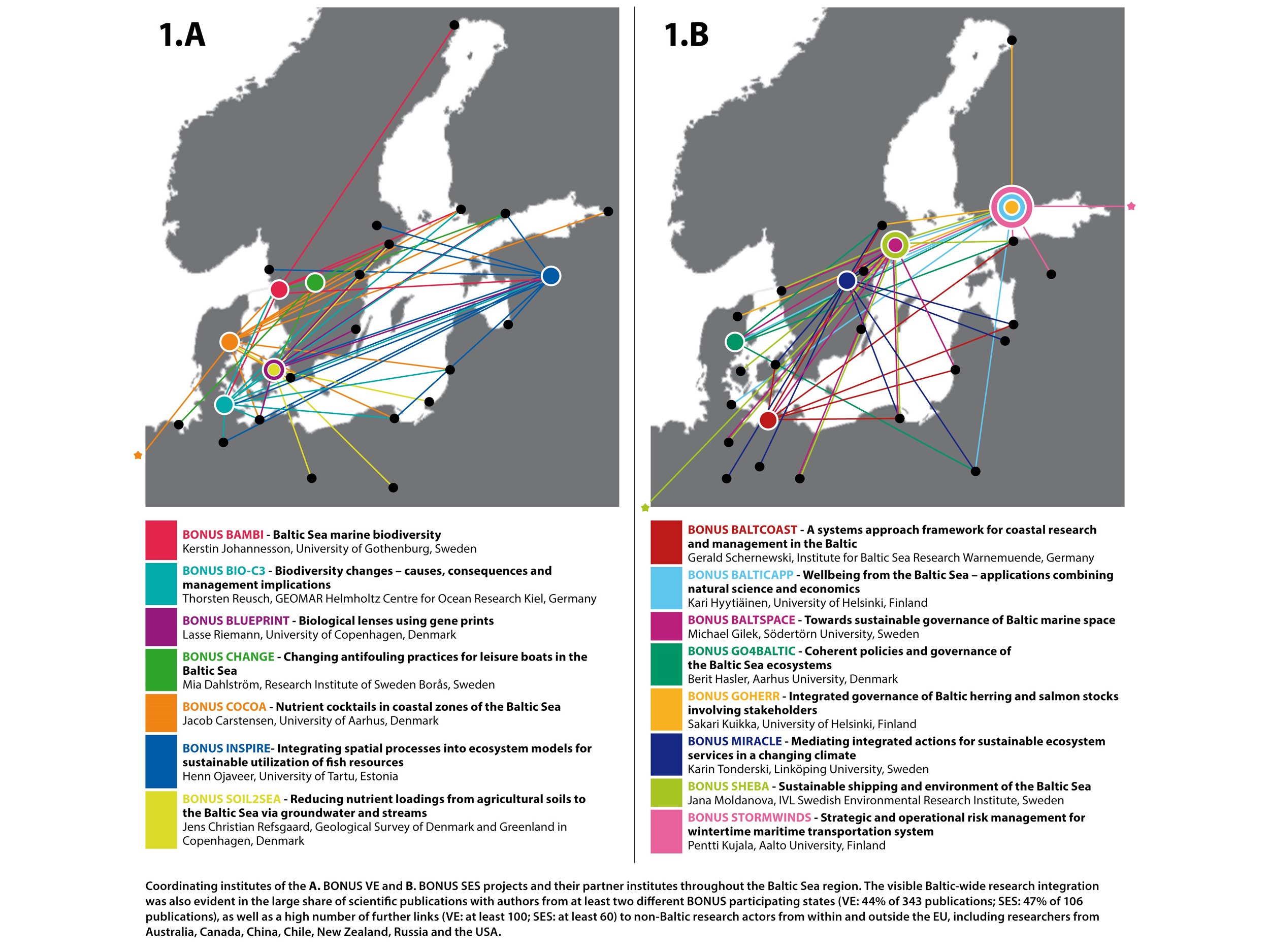
The projects’ performance statistics data collected by BONUS, the joint Baltic Sea Research and Development Programme, provides a unique source for evaluating the impact of all projects funded by five BONUS calls issued between 2012 and 2017. These statistics comprise 19 categories, resulting in an extensive database on contributions to development and implementation of policy, regulatory management, stakeholder engagement, cross-border research integration, academia links and dissemination. The projects enhanced collaboration amongst the projects. For instance, events organized jointly vary from BONUS Symposia i.e. the 1st Symposium held in 2017 jointly by BONUS BIO-C3 and INSPIRE and with contributions from eight other BONUS projects and two BONUS+ projects through their earlier data, to summer schools of 2015 and 2016 by BONUS BAMBI, BIO-C3, COCOA, and INSPIRE titled “The Baltic Sea: a model for the global future ocean?” and to workshops “Baltic Sea – a time machine for the future coastal ocean” in 2016-2017 held by BONUS BALTICAPP, BAMBI, BIO-C3, COCOA, GO4BALTIC, INSPIRE, MIRACLE and SOILS2SEA. The breakdown of the at least 230 times that the projects contributed to the development and implementation of regulations, policies and management practices aimed at safeguarding the sustainable use of Baltic Sea ecosystem’s goods and services entails a 42 % share towards providing management and policy recommendations, a 37 % share towards closing the gap between science and management, and enhancing Baltic Sea ecosystem approach to management, a 15 % share of contributions towards EU strategies and directives and a 6 % share towards updating and developing indicators and descriptors for the Baltic Sea Good environmental Status. These 15 projects also engaged at least 1200 times with stakeholders of the region. Key results from 15 BONUS projects: BAMBI Genetic diversity matters and needs better recognition and implementation in the design of Baltic Marine Protected Areas BIO-C3 Biodiversity and ecosystem function of the present Baltic Sea as outlook for the future coastal ocean BLUEPRINT Environmental conditions in the Baltic Sea can be predicted from microbial genetic information contained in a water sample CHANGE Biofouling on leisure boats can be prevented by much less-toxic antifouling paint than currently used in the Baltic Sea or using alternative antifouling measures COCOA Nutrient turnover in the coastal zone varies between the major Baltic coastal types with implications for nutrient management INSPIRE Solving the question where which fish is when and why with implications for Baltic fisheries management SOILS2SEA Adjusting nutrient management strategies to present and future local conditions in the catchment can significantly reduce nutrient loading to the Baltic Sea Read more: www.bonusportal.org/files/6518/BONUS_Briefing_31_VE_outcome.pdf BALTICAPP A healthy Baltic ecosystem is not only a public priority but also an achievable goal BALTCOAST A revised Systems Approach Framework can improve Baltic coastal management BALTSPACE An interdisciplinary analytical framework can improve integration and sustainability in Baltic Maritime Spatial Planning GOHERR Dioxin input to the environment, rather than fisheries management measures, must change in order to reduce dioxin concentrations in Baltic herring and salmon GO4BALTIC Cost-efficient solutions for agricultural nutrient management exist but might be challenging to implement in practice MIRACLE Stakeholder integration as key to successful regional water resource management SHEBA Impact of shipping-related emission and noise pollution of the Baltic Sea accessible via a Driver-Pressure-State-Impact-Response framework STORMWINDS A framework of analyzing tools can increase safety of winter-time passage in the northern Baltic Sea Read more: www.bonusportal.org/files/6519/BONUS_Briefing_32_SES_outcome.pdf