AGePOP: how young researchers will revolutionise drug formulation for our ageing population


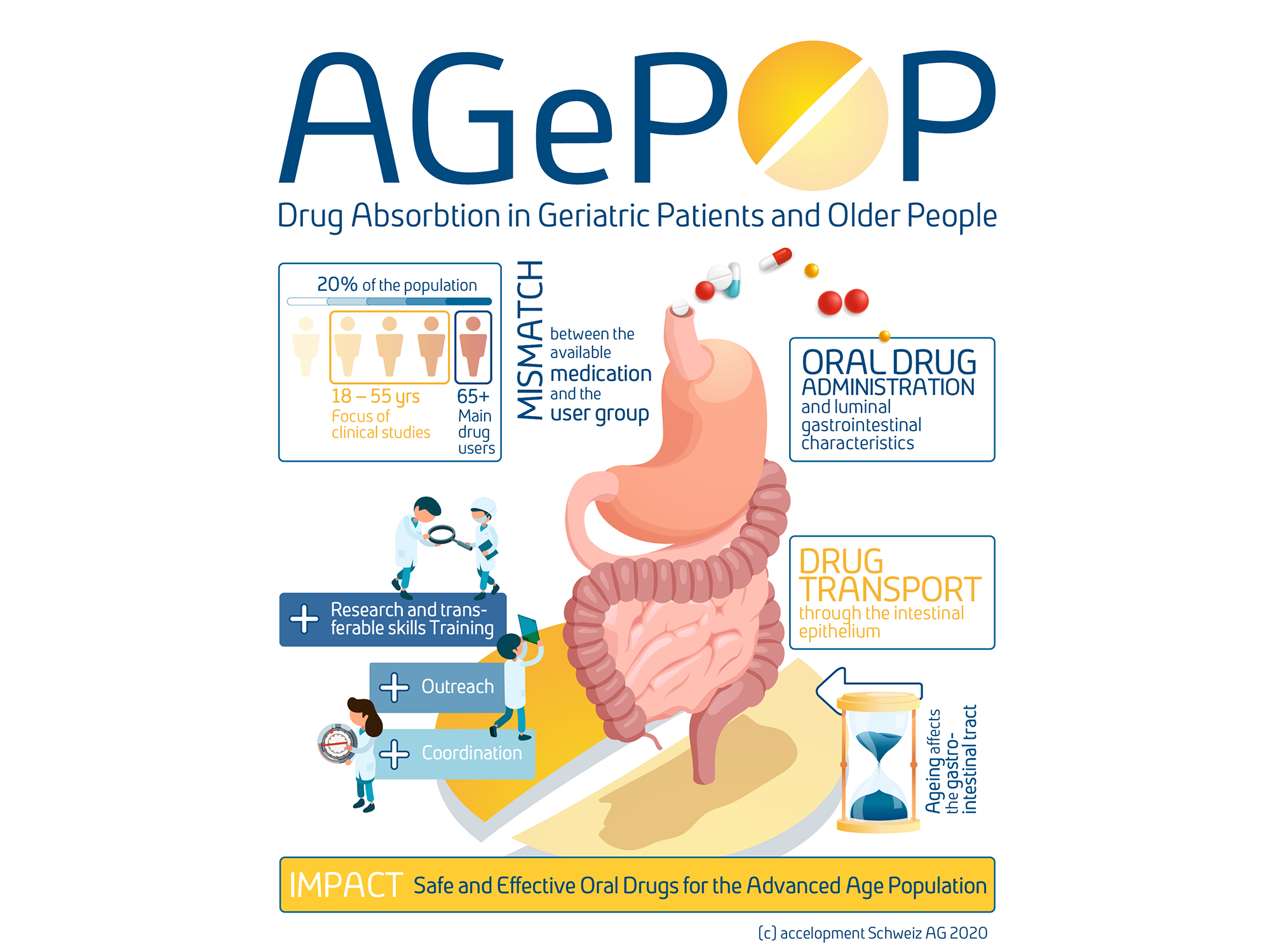
There are almost 91 million people aged 65 or over in Europe. They make up the advanced age population, and represent 20% of the total European population. Older age is accompanied by an increase in the number and complexity of illnesses, including that of chronic diseases, making the advanced age population the key end-users of oral drugs. Yet, these end-users are disregarded in the drug development process. Clinical evaluation of oral formulations is typically carried out on healthy adults aged 18-55 and do not take into account the changed physiological needs of older people and geriatric patients. AGePOP, an EU-funded H2020 project on Drug Absorption in Geriatric Patients and Older People, will lay the foundation of oral drug product development focusing on the advanced age population. As a research and training network, AGePOP brings together 13 organisations from 5 European countries, with leading experts in oral drug absorption and development, clinical research and practice, mentoring and training. AGePOP’s main aim is to revolutionise drug formulation, to benefit society as a whole. Picture Claire, a 72 year old woman affected by rheumatism and Alzheimer’s disease. She has to regularly take 4 different oral medications, with additional pills in case of acute illnesses. Rheumatism makes the handling of medication cumbersome, while Alzheimer’s affects her ability to swallow it. She is assisted by her son Mark, who despite supporting her medical care has had to take Claire to hospital many times already because the medication isn’t effective. What AGePOP aims to do is develop new ways to formulate drugs in a way that they can be more easily administered, swallowed and absorbed, so that Claire and many others like her can take the medicine more easily and count on their curative effect. The load on caregivers like Mark will as a result also be lessened, allowing them to spend more quality time with their family. The AGePOP research, kicked-off in January 2021, will start right at the bedside of geriatric patients and older people. The physiological characteristics of their gastrointestinal tract and its behaviour upon intake of oral drugs, which are currently unknown, will be studied and compared with those of younger, healthy adults. This new knowledge, combined with the development of innovative methodologies, will enable the researchers to suggest new drug formulations for safe and effective administration to the advanced age population. By the end of the project in 2024, they will also develop a mobile test kit to collect large data sets on gastric emptying and the transit time of oral formulations, and an absorption risk calculator to assess the probability of side effects in geriatric patients and older people already during drug development. Through these innovations, people like Claire could benefit from drugs that take into account bodily changes due to advanced age. This societally relevant study will be carried out by 11 Early Stage Researchers, who will be trained by expert scientists from academia, industry and clinical practice, to become the future leaders in drug development. Their top-class research will be complemented by training in business and transferable skills, preparing them to support better and more personalised patient care, well beyond the 4 years of the project. ‘Older people represent our own subsistence in the past and the wisdom of human beings prior to our existence. Increasing the effectiveness of drug products to this population is a debt of honour’, says Maria Vertzoni, the coordinator of the AGePOP project. Follow the journey of AGePOP and its researchers on www.agepop.eu and on Twitter @AGePOP_H2020. Project Beneficiaries: - National and Kapodistrian University of Athens, GR - Katholieke Universiteit Leuven, BE - Universitaet Greifswald, DE - F. HOFFMANN-LA ROCHE AG, CH - Merck Healthcare KGAA, DE - Bayer AG, DE