Empowering first responders during emergencies


Besides calling them heroes, is there a way to make the job of first responders – firefighters, police officers and paramedics – easier, safer and more efficient? According to the EU-funded RESCUER(opens in new window) project, with the right digital solutions, the answer is ‘yes’.
Access to real-time information
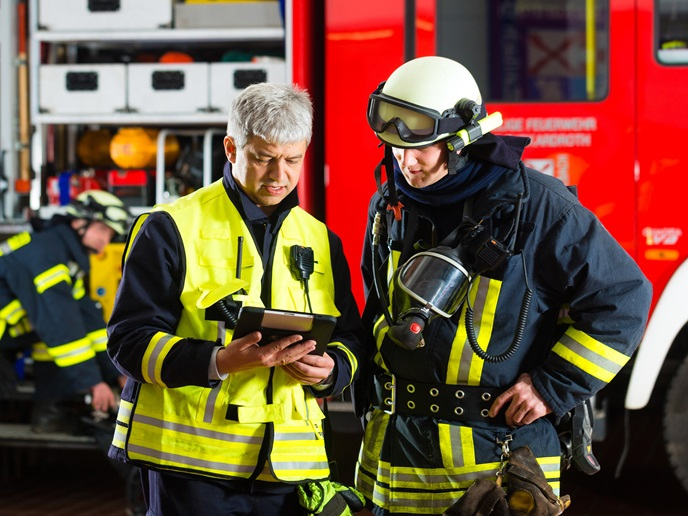
“Digital tools give first responders access to real-time information, better communication and clearer situational awareness, allowing them to make faster decisions, stay safer in the field and better coordinate command and control,” explains Federico Álvarez, RESCUER’s project coordinator. Of course, for these tools to be useful, they must function reliably even in harsh and unpredictable operational conditions. To help fill this gap, the RESCUER project has developed a suite of cutting-edge technologies, including sense augmentation, infrastructure-less positioning(opens in new window), and cognitive support interfaces.
Integrating cognitive load measurement
One of those technologies is the enHanced nEw eRa first respOnder (HERO) concept. First responders increasingly use augmented reality interfaces such as holographic displays to visualise critical data. The HERO concept takes this one step further by integrating cognitive load measurement. “What this means is that the system adapts information to one’s stress levels, preventing overload and supporting better decision-making,” says Álvarez. “This combination of real-time situational data and cognitive insights enables faster, safer and more informed actions in complex emergencies.” The RESCUER toolkit is also designed as an integrated system. “This allows information from different sources to be visualised together, enabling command-and-control teams to track events in real time and make better-informed decisions,” notes Álvarez.
Unpredictability of real-world emergencies
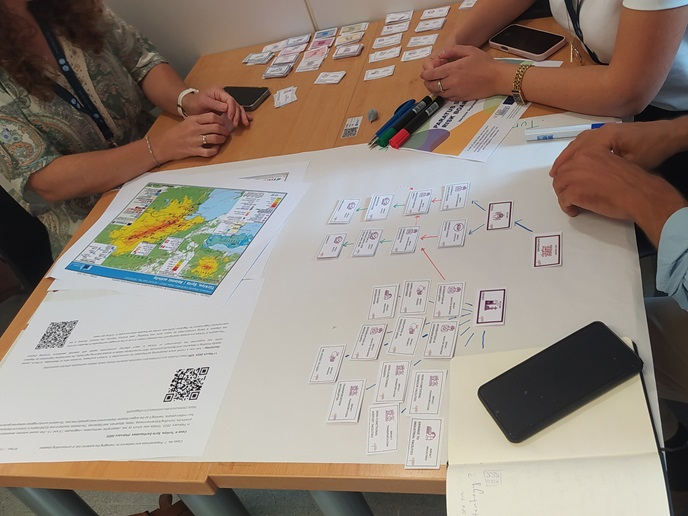
Nonetheless, bringing cutting-edge technologies to the frontline remains challenging. “While the convergence of artificial intelligence, robotics and sensor technologies holds promise, introducing these technologies in the field of emergency response can be difficult,” adds Álvarez. That’s because real-world emergencies are unpredictable, and technology must be adaptable and resilient. Furthermore, compatibility issues, user interface complexities and the need for tools to function in harsh environments also pose obstacles. To ensure its tools were fit for real-world applications, RESCUER followed a rigorous validation process, including pilot exercises designed to test the technologies in the field. Álvarez remarks: “Pilot exercises in emergency-centred research projects are complex and time-consuming events due to the necessary planning, preparation and flexibility to conduct them successfully and overcome setbacks.” RESCUER organised 10 field trials, seven training sessions and six pilots, testing the toolkit’s components in diverse scenarios. The project also developed detailed evaluation methodologies to assess the performance of each tool, accounting for technical limitations such as battery life, which limited scenario duration to 45 minutes. The pilots provided researchers with valuable insights, enabling them to refine the tools and ensure they met actual first responder needs.
Stronger, more reliable crisis response
By providing access to real-time information and enabling better communication and clearer situational awareness, digital solutions such as those developed by the RESCUER project help first responders make faster, better decisions while also keeping them safer in the field. “RESCUER helps Europe be better prepared by giving both first responders and command-and-control teams clearer awareness of what’s happening on the ground, even in infrastructure-less environments,” concludes Álvarez. “This means they can react faster, coordinate more effectively and act in a safer manner – ultimately leading to a stronger, more reliable response during a crisis.” The project consortium is in discussions with industrial partners and companies interested in converting its technologies into products that could be available to first responders within the next two to three years. The ambition is to turn RESCUER’s innovations into practical, regulated tools that can be widely adopted by emergency services across Europe.