Where do comets come from?

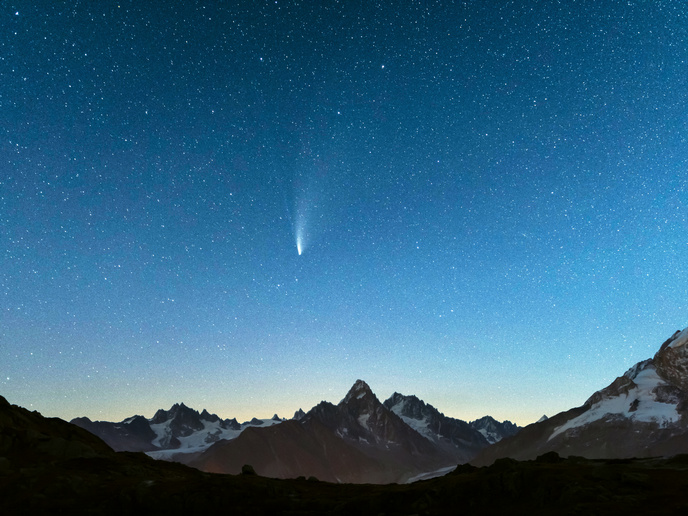
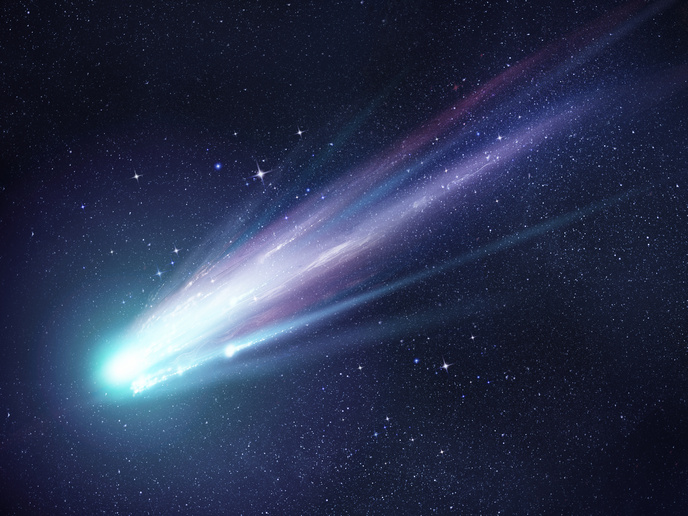
“Comet should really be a verb, rather than a noun,” says Guilbert-Lepoutre from the French National Centre for Scientific Research. “This is because astronomers have started to think of small bodies in our solar system on a continuum (from rocky and metallic through to icy). Recently for example, we detected cometary activity among some asteroids in the asteroid belt.” The comets that light up our skies are small bodies of rocky material and ice left over from when our solar system was formed over 4.6 billion years ago. What makes these so-called ‘dirty snowballs’ different from objects such as asteroids is their coma, the fuzzy, cloud-like atmosphere and tail that forms from the sublimation of its ice as the comet nears the sun.
The cloud and the belt
Broadly speaking though, there are two key regions where comets come from – the Kuiper belt, beyond the orbit of Neptune, and the Oort cloud, on the very edge of our solar system. Out here it is so cold – well below minus 200 degrees Celsius – that anything containing ice is guaranteed to keep it. “Comets are remnants of a much larger population of small objects that were ejected outwards during what we think must have been a period of giant planet instability,” explains Guilbert-Lepoutre. “They ended up in these two large reservoirs.” The orbits of these comets are largely governed by the giant planets and can change over time. Comets can be launched into the inner solar system – where we might see them – or ejected from the solar system entirely. “Comets from the Oort cloud are known as long period comets, with orbital periods that can reach up to 1 million years,” adds Guilbert-Lepoutre. Hale-Bopp, which appeared in our skies in 1997, won’t pass by again until sometime around the year 4 500. Comets found in the much closer Kuiper belt also trickle down to the inner planetary system. These can have shorter orbits, typically less than 200 years. A good example would be 67P/Churyumov-Gerasimenko, onto which the European Space Agency (ESA)’s Rosetta(opens in new window) mission placed a lander. That’s not all though. We also know there are interstellar comets, originating from other planetary systems in the galaxy that drift between stars. “We have identified three of these since the first discovery of Oumuamua in 2017,” remarks Guilbert-Lepoutre. “These bodies drift in the interstellar medium, where they might encounter a star and change course.”
Pristine survivors of our solar system
One reason why astronomers such as Guilbert-Lepoutre are so interested in comets is what they can tell us about our own origins. Comets are believed to be the most pristine survivors of our solar system’s formation, potentially providing us with clues about the prevailing conditions at that time. This was investigated in depth through the European Research Council(opens in new window) funded THEMISS project, which sought to understand how comets have evolved. An exciting development on the horizon is the ESA’s Comet Interceptor(opens in new window) mission, which will help us learn more about comets originating from the Oort cloud. Scheduled for launch in 2029, a spacecraft will be ‘parked’ in space before moving to intercept a suitable pristine comet. Two probes will be released to observe the comet from multiple directions at the same time. “We know which reservoir comets come from due to their orbital properties,” notes Guilbert-Lepoutre. “But never know exactly where though, or when exactly they will return due to the chaotic and unpredictable nature of space.” For Guilbert-Lepoutre, this is part of why comets are so captivating. “My first experience of comets was as a child, looking up at Halley Bopp. It was so incredible, the fact that it was so visible to the naked eye and yet we’ll never see it again.” Read more about Aurelie Guilbert-Lepoutre’s research: Comet evolution key to understanding the cosmos