AI-powered stroke telerehabilitation at home

Stroke is the second leading cause of death worldwide, with over 13.5 million cases annually and 100 million survivors living with long-term impairments. Europe alone faces billions of euro in healthcare costs, which is expected to rise by 2045. At the same time, global health systems confront critical workforce shortages, creating an urgent need for efficient, scalable rehabilitation solutions.
Personalised care pipeline
Many stroke survivors experience post-stroke cognitive impairment or dementia, affecting memory, attention, mood and communication. Functional gains achieved in hospital are frequently lost after discharge, contributing to a high readmission rate within six months. The EU-funded PHRASE(opens in new window) project aims to break this cycle with personalised, AI-supported rehabilitation delivered seamlessly from hospital to home. It has been designed to enable shorter, and more efficient hospital stays by safely moving part of rehabilitation and monitoring into the patient’s home. The same six-week programme that in many settings would require repeated on-site visits can now be delivered largely at home. “We built a single pipeline that connects clinical data and home-training information to an AI ‘coach’ that personalises therapy to maximise patient outcomes” explains the CEO of Eodyne Systems(opens in new window) Santiago Brandi.
A digital rehabilitation ecosystem
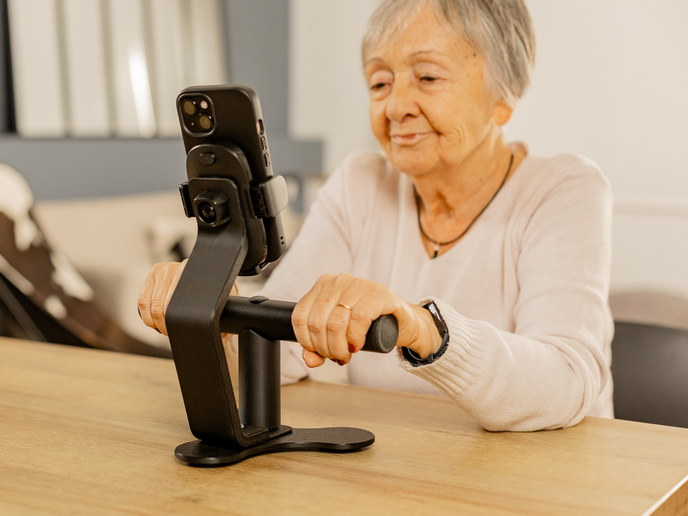
Stroke patients train and are assessed using RGS (Rehabilitation Gaming System) Ecosystem, both in the clinic (RGSclinic) and at home using a smartphone app (RGS+ app) and a smartwatch (RGSwear). During short game-like clinical exercises, the system records how patients move (speed, smoothness, range of motion) and how they perform in cognitive tasks (memory, attention, accuracy, reaction time, difficulty reached). These digital measures are combined with standard clinical scales collected by therapists and stored in a secure cloud. This data also integrates with the EBRAINS(opens in new window) open infrastructure for brain-related research. AI then operates on this data to provide digital diagnosis with week-by-week estimates of clinical scores. Recovery prediction models also forecast patient progress, and a personalisation engine keeps training at an optimal challenge level based on real-time performance.
Technical advances and patient insights
The team has created new cognitive training protocols and improved body-tracking algorithms to reduce equipment costs, whilst complying with stringent privacy guidelines and ethics. Adoption has exceeded expectations. In a multi-centre feasibility study involving 88 participants, adherence reached 83 % over a six-week home-based programme, remarkably high for neurorehabilitation. Patients valued intuitive interfaces and flexible home training, while clinicians appreciated reduced administrative burden and richer, objective monitoring. Feedback led to refinements such as age-appropriate instructional videos and automated fatigue-management prompts. Definitive evidence on clinical effectiveness will come from the ongoing randomised controlled trial across multiple European centres. “The most significant achievement of PHRASE is that it made personalised, AI-supported telerehabilitation affordable and available for autonomous home use in real-world conditions,” emphasises Brandi. Next steps include the certification of the PHRASE solution under the EU Medical Device Regulation and integrating PHRASE into European reimbursement systems. A sustainability plan outlines centralised, hospital-hosted and hybrid deployment models compatible with GDPR and national procurement systems.