


New thermal ‘battery’ offers smarter way to store solar heat


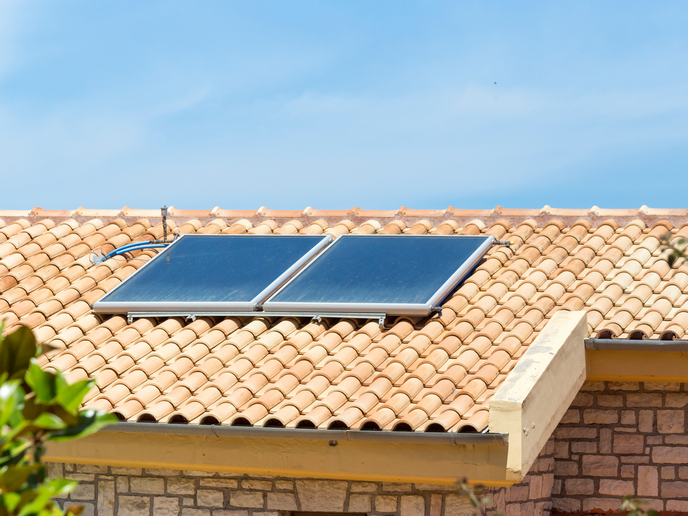
EuteQ tackles one of the key challenges for renewable heating in Europe: storing solar heat efficiently and at high density so that households can use PV electricity to cover more of their own heating demands.
Philipp Roos, head of systems engineering at Cowa Thermal Solutions
A European research project called EuteQ is exploring new ways to help households store and use solar heat more efficiently, by developing compact, high-density ‘thermal batteries’ that make renewable heating more flexible and practical. Supported by the EU through Horizon Europe(opens in new window), Innosuisse(opens in new window) and DLR(opens in new window), the project managed to accelerate SME-led clean-energy technologies. “EuteQ tackles one of the key challenges for renewable heating in Europe: storing solar heat efficiently and at high density so that households can use photovoltaic (PV) electricity (or other intermittent renewable electricity sources) to cover more of their own heating demands,” explains Philipp Roos, head of systems engineering at Cowa Thermal Solutions, a Swiss cleantech company based in Lucerne, Switzerland.
High-density storage using special salts
Conventional water tanks store heat simply by warming water. They are bulky and inflexible. EuteQ’s solution uses phase-change materials (PCMs)(opens in new window) – special salts that absorb and release heat as they melt and solidify. These PCMs can store up to three times more energy than a traditional tank of the same size. “The newly developed Cowa COMPACT Cell increases the system performance even further, with optimised heat transfer for maximum power density suitable for domestic hot water (DHW) storage,” Roos notes. In practice, these compact cells replace standard water tanks, creating a highly compact storage system where water is heated on demand, flowing through a heat exchanger embedded in the PCM. Water carries the heat, while the PCM adds high-capacity storage at tightly controlled temperatures: 48°C and 58°C are currently available for domestic hot water and room heating. At the pilot site in Northern Germany, one residential building is equipped with PCM-enhanced tanks, while a neighbouring building uses standard storage. The result? A real-world comparison showing how much more efficient and flexible renewable heating can be. “Together, these components form a hybrid sensible–latent storage concept operating across both room-heating and DHW temperature zones,” says Roos.
Boosting flexible solar energy consumption
A standout feature is the system’s synergy with rooftop solar panels. When the sun shines, PV-driven heat pumps charge the PCM tanks, storing energy for later use and reducing reliance on the electricity grid. Early simulations show that this approach boosts solar energy consumption and makes heating more predictable, even when sunlight is scarce. EuteQ’s achievements highlight the value of European collaboration. The project brings together partners from Switzerland and Germany, including Cowa Thermal Solutions, ZAE Bayern, HSLU and Varmeco. “The partnership benefits strongly from cross-border industrial–research cooperation, coordinated work packages and shared data infrastructure, enabling fast iteration between modelling, materials, product design and validation,” Roos explains. The potential impact is significant. Widespread adoption could shrink tank sizes, improve seasonal energy flexibility, lower costs and help European households rely more on renewable electricity. “Strong industry–research coordination accelerates technology maturation,” Roos adds, noting that discussions are already underway to bring PCM-enhanced storage systems to market. Thanks to EuteQ, the vision of compact, efficient and solar-powered home heating is no longer a distant idea. It is a practical, scalable technology that could make renewable heating the norm, not the exception. Building on the project’s results, the next steps for EuteQ focus on further system optimisation, large-scale demonstration and market rollout through industrial partners. With strong potential for integration into existing domestic heating systems, PCM-enhanced thermal storage could become a commercially attractive solution for households across Europe seeking compact, flexible and renewable heating. The consortium brought together Cowa Thermal Solutions, the Lucerne University of Applied Science and Arts, the Bavarian Center for Applied Energy Research and Varmeco, co-funded by Horizon Europe, the Swiss Innovation Agency (Innosuisse) and the German Aerospace Center (DLR).