



Does gravity work differently at the scale of the universe?

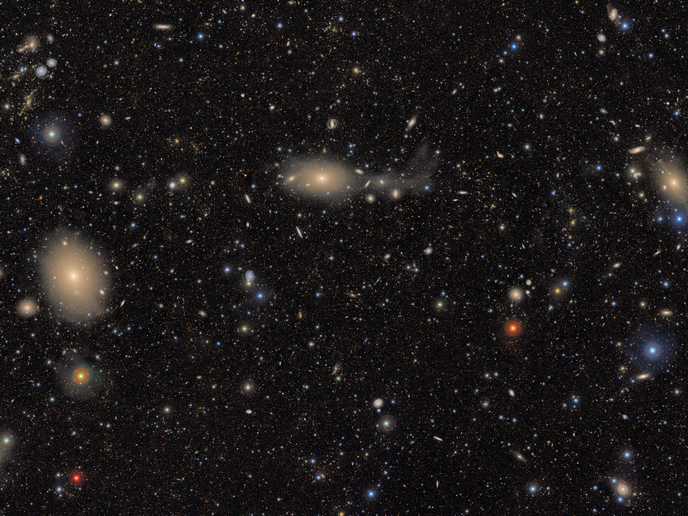
Cosmologists have known since the 1930s that our universe is expanding – a phenomenon that fits with Einstein’s theory of general relativity. In 1998 however, it was discovered that this expansion is accelerating. We do not fully understand why this is happening. Nonetheless, scientists have identified a number of possibilities. One could be the existence in the universe of dark energy, which possesses properties we have yet to explain. Another is that we do not fully understand how gravity works at very large distances, beyond the scale of galaxies – perhaps Einstein’s theory of general relativity doesn’t hold at this scale. “A key question for cosmologists is which approach is correct,” says LSSgrav project coordinator Camille Bonvin from the University of Geneva(opens in new window) in Switzerland. “My aim in the LSSgrav project was to develop new ways of testing the rules of gravity at very large distances.”
Large-scale structure of the universe
To achieve her aims, Bonvin, who was supported by the European Research Council(opens in new window), looked at the large-scale structure of the universe. A major element of this was to see how galaxies, which are pulled into clusters and cosmic structures by gravity, are distributed. A key point here is that we don’t see galaxies exactly as they are. The light we see is distorted by many factors, for example if the galaxy is sitting inside a dense cluster. “While cosmologists have tended to see this distortion as contaminating measurements, my approach was to see this distortion not as noise, but as a signal,” notes Bonvin. “Because if we can infer the distortion of space and time from the distribution of galaxies, we can use this to test the laws of gravity.”
Dark matter in the universe
Bonvin set out to develop ways of measuring these distortions – not an easy task. Novel observational methods were developed to isolate and boost these effects. “When we run tests like this, we always have to be careful,” explains Bonvin. “We know we are missing something – the dark matter that we know is in the universe – and it is difficult to make a distinction here. If there is some anomaly, is it because the theory of general relativity is wrong, or is it because of dark matter behaving in an unusual way?” Applying her new observable technique to synthetic data that are mimicking what the newest generation of surveys will measure, Bonvin was able to show that it was possible to distinguish between gravity and dark matter. “We showed we can test the theory of gravity by comparing the distortion of time with the distortion of space, to see if they are the same or not,” she says. “Theory tells us that these distortions should be the same. If they are not, then this means that Einstein’s theory of general relativity is not correct at cosmological distances.”
Distortion of time and space
The positive results of this new approach open up new ways of thinking. “We always have to be careful with the hypotheses we are making,” adds Bonvin. “We should accept that there are many unknowns. This observable approach is about bringing the necessary information needed to make distinctions.” Bonvin intends to pursue this line of inquiry further, applying her approach to the new generation of data that are currently being collected, to conduct tests and help to discriminate between gravity, dark energy and dark matter. This could help to answer a range of cosmological questions, including why the expansion of our universe is accelerating.