Tools to capture evolution of galactic mergers

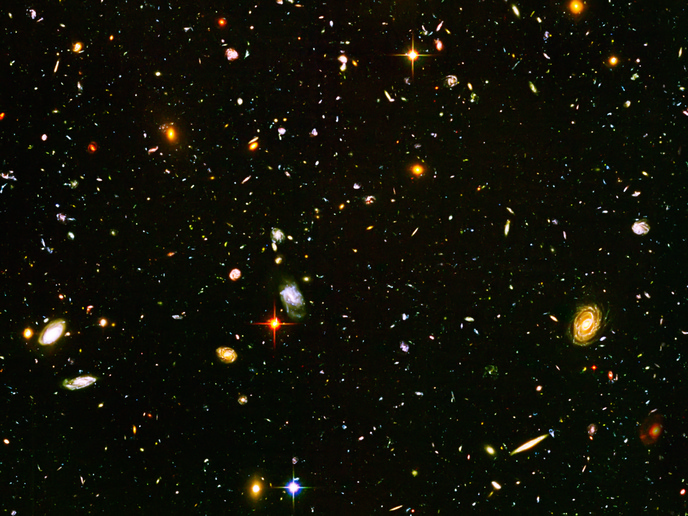
Galaxies are the largest gravitationally bound objects in the universe – enormous islands of up to hundreds of billions of stars, accompanied by huge clouds of gas and dust and, likely, an even larger mass of dark matter. Galaxies show a wide range of properties in terms of size, shape, star population and internal structure. “The question of how these galaxies ended up looking like they do comes to mind,” says GalaxyMergers(opens in new window) project fellow Ivana Ebrova from the Institute of Physics of the Czech Academy of Sciences(opens in new window). “It turns out that the evolution of galaxies has been going on over most of the age of the universe. Understanding galaxies today therefore means understanding their history, and the history of the universe as a whole.”
Understanding the process of galaxy mergers
Supported by the Marie Skłodowska-Curie Actions(opens in new window) programme, Ebrova wanted to better understand the process of galaxy mergers as a critical element of cosmic evolution. Galaxy mergers are slow processes, happening over millions of years. Information about merger history must therefore be indirectly derived from the present day. “Luckily, a significant portion of elliptical and lenticular (lens-shaped) galaxies show a unique type of fine structure known as stellar shells,” adds Ebrova. “These are created in mergers and can be used to date the last significant merger that the galaxy has undergone.”
Shell detection, measurement and modelling
In the GalaxyMergers project, Ebrova built on existing methods to extract such information from individual galaxies. “The aim of the project was to expand the applicability of these methods to vastly larger samples,” she explains. “To this end, we developed new tools to identify and analyse shell galaxies in images of large sky surveys, so that the estimates of merger times can be automatically obtained.” Visualisation tools were developed that allow fast visual inspections of galaxies by generating composite images with multiple scales. This facilitates the identification of shells simultaneously in the inner and outer parts of the galaxy. An algorithm for modelling shell evolution was developed and validated using shell galaxies produced in cosmological simulations. These tools – for shell detection and measurement, determination of gravitational potential of the host galaxy and modelling shell evolution – have since been made publicly available(opens in new window) as free and open-source software.
Shell galaxies as points of reference
The GalaxyMergers project has helped to transform shell galaxies from objects of curiosity into useful points of reference. Data from hundreds of shell galaxies can be found in existing surveys, and this is likely to expand to thousands of galaxies with the Vera C Rubin Observatory’s Large Survey of Space and Time (LSST) project coming online. “Before the project, scientists were using various single-purpose tools, which required a significant amount of input and manual data management,” notes Ebrova. “Our integrated tool chain allows for fast and efficient workflow. This automation will be necessary for processing overwhelming amounts of data soon to be generated by the LSST project.” The project has also produced and made available catalogues of processed data. “For example, we compiled a pilot sample of 11 shell-hosting prolate rotators – a special class of galaxies of particular interest from the point of view of stellar evolution – and applied our merger-dating process on them,” says Ebrova. “This provides a first example of the potential impact of this project.”